#3 in series: Our Windmills Were Our Workplaces
Introduction: Authenticity Matters
My mother, Sherrill Foster, first studied Hook Mill for her 1976 master’s thesis on East Hampton’s windmills. She returned to Long Island’s mills again and again over the decades—in columns, talks, and walking tours—and on community days she was a docent, standing outside Hook, explaining the Dominy family of craftsmen and pointing out the millstones quarried “in the Gunks” of the Hudson Valley.
She told me that as a girl she would join her grandfather at “old Hook” on weekends, watching as he demonstrated milling to the public. In retirement, Grandpa Parsons had become a skilled woodworker, building a shop in his house on Newtown Lane.
Sherrill valued primary sources. When she came across a name like Shem—no last name—working alongside Nathaniel Dominy V on Gardiners Island, she included him. These records held truths, and she believed the full community belonged in the story.
This essay draws together her research—her thesis, columns, walking tours—to tell the story of Hook Mill and the many mills built by the Dominy craftsmen. It follows Nathaniel Dominy V—best known for furniture—as he emerges as a master millwright on eastern Long Island.
The evidence lies in the mills themselves: all-wooden gearing, refined for safety, efficiency, and durability. At a time when others were incorporating cast iron, Dominy’s commitment to wood reflects both technical confidence and a philosophy—working with local natural materials rather than imported ones. Hook Mill, built in 1806 became the model for others.
By tracing the mill investors—ship captains among them—Sherrill reveals how commerce functioned: its ties to the coastal trade, the way families sustained themselves across generations, and its connection to whaling.
Hook Mill and its green were acquired by the Village when my mother was an infant. As a child helping her grandfather there, she may even have met Charles Mulford Dominy, the last miller and custodian. She grew up knowing the Dominys’ long role in building, repairing, and running the mill—and the uncertainty that once surrounded the survival of their house and shops. The timing to preserve it coincided with December 1941 — and everyone mobilized for WWII, my mother among them, joining the Army Air Corps. Years later, she applauded Winterthur’s accession and scholarship of the Dominy craftsmen’s work. She did not live to see East Hampton’s own Dominy House and Shops Museum.
She loved what we still admire about Hook Mill—its authenticity. Like East Hampton’s farms, public greens and historic homes, it reflects a lived landscape.
Built as the town expanded northward, it anchored a new green and served a growing maritime economy. Today it stands as a testament to generations who chose to preserve what was built and held in common—at the heart of East Hampton’s heritage.
1806 Hook Mill Syndicate and The Dominys’ Many Mills
By Sherrill Foster, East Hampton Town Historian 2003-2007
Sherrill Foster's study of East Hampton's windmills began with her 1976 master's thesis and continued through columns, talks, and walking tours into the early 2000s. This series draws on her research and writings, edited and expanded on by Mary Foster Morgan, 2026. This is the 3rd essay of Our Windmills Were Our Workplaces, a series.
The abundance of wooden windmills is one of the many intriguing things about eastern Long Island. It is noted in nearly every account of our mills: eleven still stand—the largest group in the nation.
When you drive through East Hampton village, you can’t miss Hook Mill standing on the Green at the north end of Main Street. “Hook” sometimes called “Old Hook” was built by Nathaniel Dominy V in 1806 — the fifth generation of Dominys in East Hampton, and the fifth Nathaniel Dominy.
Unlike most mills – named for owners or millers — Hook Mill takes its name from Hook Pond, a freshwater pond shaped like a fishhook and separated from the ocean by dunes. The pond’s drainage (“dreen”) roughly parallels Egypt Lane, and “down Hook” came to describe the low-lying land north of the village.
This area, now the North Main Street Historic District, was first laid out in 1673 as East Hampton expanded. Younger sons needed land, and new home-lots were arranged along a broad common—an arrangement typical of New England towns.
A New Green as the Town Expands North
A common green was the center of the new neighborhood, where at least one early post mill—dated 1736—once stood. The North End Burying Ground followed in the 1750s. Together, they reflect a carefully planned landscape: homes, common land, and shared resources.
The Dominys were likely central to this expansion. Nathaniel Dominy II (1684–1769) served as surveyor, assessor, tax collector, highway commissioner, and constable. As Jeannette Rattray records, he even “looked after the clock” in 1735. Long before Hook Mill, the Dominys played a role in the civic management and physical structure of the town.
The Dominys “Down Hook”
North of the mill past the present railroad overpass lay sandy, marshy ground known as “Sandy Hook.” Sheep, cattle and horses were grazed on common lands (now the site of the East Hampton Historical Farm Museum.) Cedar Street led northwest to woodlots in what would later become Northwest Woods. Early families to farm the area were Talmage, Lester, Conkling, Miller, Osborn and Hedges.
By 1730, the weaver and surveyor Nathaniel Dominy II and his son were operating a wind-powered sawmill in this area. By 1740, the family had expanded both their home and workshops. The younger Nathaniel had married, and had purchased a nearby c. 1715 saltbox home. His son, Nathaniel Dominy IV (1737-1812) — the “clockmaker”— added a woodworking shop, producing the furniture for which the family became renowned.
By 1798 the Dominys had added a small ingenious forge for a separate clockmaking shop. Then there were three generations working together: building clocks, crafting furniture, and constructing mills. Their shops on North Main Street became a center of production so active that they hired others to farm their land.
This working landscape – clockshop, woodworking shop, sawmill, skilled labor and generational knowledge —formed the foundation from which Nathaniel Dominy V would build Hook Mill in 1806.
A New Syndicate Forms
Mills were expensive ventures. Investors formed partnerships, each holding shares and receiving both profits and milling privileges.
The earlier 1736 post mill had four investors. By contrast, the 1806 Hook Mill was financed by eight. Shares ranged from ¼ to ⅛ to 1/16, with Captain David Hedges (1769-1840) holding the largest share - he also owned the largest share of the earlier 1804 Gardiner Mill. The Dominys themselves held one-eighth.
Another shareholder, at 1/16 share, was Abraham Parsons (1772-1844), town clerk and former supervisor, whose family lived nearby the mill site, in a 1790 salt box now called “The Mill House.”
This partnership structure reveals that Hook Mill was not a private enterprise but a shared economic engine— bringing together farmers, merchants, and ship captains whose livelihoods depended on reliable grain production.
Why Another Mill So Soon?
The construction of another smock mill just two years after the Gardiner and Miller-Pantigo mills—and so close by—reveals strong demand for flour, driven not only by local households but by the growing maritime economy.
Hook Mill’s location on the northern edge of town offered excellent wind exposure while serving a different group of farmers. It was part of a deliberate expansion of milling capacity across the town. From these mills, flour moved through nearby harbors—Sag Harbor, Three Mile Harbor, and Northwest Harbor—into regional trade networks connecting to New York and Newport, and as whaling became more active, provisioning whaleships.
Building the Mill, Perfecting the Art
When Nathaniel Dominy V built Hook Mill, he was 36. His home and shops were a short walk down the hill where his wife Temperance (Miller) and their two young children lived with his father, Nathaniel IV, now 69, still at work in his 1798 clockshop.
Hook Mill is an octagonal English smock mill, and in it Dominy refined his design. It preserves more of its original all-wooden machinery than any other mill on Long Island, offering a rare view of his craftsmanship.
He made engineering improvements from earlier mills – expanding the tower to allow easier maintenance, adding bracing to stabilize the mill, and refining his internal gearing system, necessitating enlarging his distinctive rounded, dory-shaped cap.
The result was a mill that was not only more productive but more durable. Dominy approached windmill construction with the precision of a cabinetmaker, creating a design that would serve as a blueprint for others.
Who Built Hook Mill?
Hook Mill, larger than other mills, required a heavier timber frame. Some timbers were supplied from Gardiners Island. Records from John Lyon Gardiner detail the transport of lumber by boat, and meals for the workers.
Gardiner’s records also name Shem, a Black laborer, and two Montaukett young men working alongside Dominy. They felled trees and hauled timbers — essential labor so often invisible in traditional histories.
Their presence reminds us that Hook Mill was not only the work of expert craftsmanship, but the product of a diverse workforce whose contributions shaped East Hampton’s landscape.
A Miller’s Workday
To keep a mill running a miller was at the mill every day, adjusting sails, turning them to the wind, and “cutting” the millstones to maintain their grinding surfaces. Flour and feed were produced only when wind allowed.
Farmers arrived by wagon with grain. Inside, large circular stones ground wheat into flour and grain into feed. The finer of the two — the buhr stone — was prized for its hard, porous texture, which held a sharp edge and produced fine white flour; the classic buhr stone was quarried near Paris and imported at real expense, though American millers increasingly turned to domestic alternatives like the durable quartz conglomerate quarried in the Shawangunks — "the Gunks" — of the Hudson Valley. Hook Mill contains two sets of stones, reflecting its expanded capacity to grind both flour and feed.
Fire was a constant danger. Fine dust filled the air, so the mill’s design allowed wind to circulate freely through and beneath it. Even the “cat’s door” in the floor reflects practical solutions—keeping rodents in check while maintaining airflow.
Hook Changes Hands
By 1850, Hook Mill was jointly owned by Nathaniel Dominy VII ((1827-1910) and Charles Hedges (1823-1881). In 1859, Dominy became sole owner, operating the mill with his sons (Nathaniel VIII, Jeremiah and Charles).
By 1860, the three East Hampton mills—Hook, Gardiner, and Pantigo—each processed about 5,000 bushels of grain annually, underscoring their central role in the local economy. Hook Mill continued to operate until 1908.
A Neighborhood Transformed
As Hook Mill milled grain, the neighborhood around it evolved. Whaling captains built homes along North Main Street, reflecting the prosperity of Sag Harbor’s maritime trade.
Capt. William Bennet, a deep-water whaler, built a Greek Revival house in 1849, set on the brow of the slope. He had been aboard the ship Italy out of Sag Harbor under Capt. Weld. They whaled in the Pacific off the northwest coast of the US in the 1840s, a two-year trip. One trip they took in 38,000 pounds of whalebone. With its high roof, the view from the whaler's house must have been lovely looking out over the marshy wetlands, common, and low hills, with a windmill near and one in the distance.
Mill-owners lived nearby. Three generations of the Parsons family lived on North Main Street, their house built in 1790, looking like Home Sweet Home. Mill owner William Parsons was the last Parsons to live there, and sold to Patrick Lynch in 1860.
Main Street itself was straightened and widened in the 19th century transforming the earlier, winding “Town Street” into the broad avenue we know today.
Yet throughout these changes, Hook Mill remained both a working enterprise and a visible landmark, anchoring the North End Green and Burying Ground
Bought by the Village
In 1922, the Village of East Hampton purchased Hook Mill and its green. Under local custodians, including Charles Mulford Dominy, Nathaniel V's great-grandson, the mill was restored and ran seasonally. Four generations of Dominys built, owned, or operated Hook Mill.
The green became a site for public gatherings, marked by a World War I memorial. Hook Mill shifted from industry to heritage—but remained central to community life.
More Dominy Mills
Nathaniel Dominy V built more smock mills than any other millwright in the region, nine in all. His first three were built between 1795 and 1806, two in East Hampton, Gardiner and Hook mills, one on Gardiner’s Island. The next three would be built between 1807 and 1810 – on Shelter Island, in Southold, and in Orient. His mills shared a consistent design: multiple sets of stones, all-wood internal gearing to turn the roof-cap and housing the gearing in his distinctive dory-shaped cap.
During these years Sag Harbor was becoming a major whaling port, one of the four most active in the country. Ships required large quantities of flour and grain for long voyages.
This demand helps explain the burst of windmill construction between 1804 and 1810. These were not isolated structures but part of a coordinated economic network linking farms, mills, and harbors.
1807 Good Ground Mill – Built on Shelter Island
The year after he built Hook Mill Nathaniel Dominy V was hired by Sylvester Dering & Company to build a smock mill on Shelter Island. Dering was a major landholder, his property inherited from both the Dering and Sylvester families which included Shelter Island Heights, West Neck and the South Ferry region. The family firm functioned in a way typical of the time—part farm, part merchant, part maritime. They had a coastal trade business with small sloops and schooners, and they provisioned the nearby port of Sag Harbor.
The Dominy-built mill operated on Shelter Island for more than fifty years before being moved to Good Ground in 1860, operating for another twenty years. Its last move was to Southampton in 1880, where it is now part of a private summer estate.
At Good Ground, now Hampton Bays, the mill served nearby farmers whose harbor outlet was Shinnecock Bay where coastal vessels loaded grain and farm products for trade west to New York along Long Island's south shore. Its name today reflects that location: Good Ground Windmill.
1810 Mill Built in Southold
Built in Southold by a consortium headed by Moses Cleveland, this mill was later moved to Shelter Island, where it still stands today as the Sylvester Manor Windmill.
Nathaniel Dominy V recorded that he charged for 66 days of his own time and 120 days for his apprentices' time. They were Asa Miller, Merry Parsons, and Lewis Parsons — all East Hampton young men who may have fabricated parts in the Dominy shop on North Main Street before transporting them by boat to Southold.
Farmers here had access to Greenport Harbor and Peconic Bay landings, connecting North Fork grain farmers to coastal trade.
The mill operated in Southold until 1840 when it was purchased by Joseph Congdon and moved to Shelter Island. Purchased again and restored by Lillian Horsford, the mill remained in the center of town until moved in 1926 to its site today, in the fields of the Sylvester Manor Educational Farm.
1810 Orient Mill
The Orient Mill, built in 1810, is widely attributed to Nathaniel Dominy V, though some credit John Terry of Orient as its builder. The mill shares Dominy's characteristic smock design and cap style, though later restorations may have altered the gearing. At some point it was moved by barge to Glen Island off New Rochelle, where it stands today.
The Orient Windmill served farmers of the Oysterponds area. The major grain-producing families of Orient — Terry, Tuthill, Youngs, King, and Latham — were most likely its investors and primary users. Their flour and grain moved through Orient Harbor, a protected anchorage opening into Gardiners Bay and Long Island Sound.
The locations of Dominy's mills — from East Hampton to Orient — form an arc across eastern Long Island and together functioned as a regional supply system supporting agriculture and maritime trade, several operating into the 20th century.
When Shipping Changed
The decline of windmills as a business followed a larger shift. The arrival of the Long Island Rail Road in the mid-19th century allowed cheaper Midwestern flour to reach New York markets.
The mode of “shipping” had changed.
The turning point started at Greenport, in 1844, when the LIRR extended its main line eastward, then to Sag Harbor in 1881 and then Montauk in 1889.
Local wheat farming declined, replaced by crops like potatoes – farmers found the sandy soils very suitable for a crop with a growing urban demand. Within a few years, the wheat fields that had sustained milling for nearly two centuries converted to potato fields, and the mills stopped milling.
What Happened “Down Hook”
While Hook Mill and its green remained central to the community, the Dominy house and shops on North Main Street faced near loss. That there is today both a Dominy Shops Museum in East Hampton and a Dominy Collection at The Henry Francis du Pont Winterthur Museum in Delaware is a story of near-loss, dispersal, chance discovery and rescue, and a community intent on preserving its heritage.
Near-loss came in 1941, when demolition of the Dominy house and shops threatened. The East Hampton Village made an effort to save them — to purchase them as they had Hook Mill — but the appeal, in December, was overshadowed by urgent world events.
However, individuals acted fast. Learning that the house was to be demolished, an architect for the Historic American Buildings Survey drafted measured drawings and arranged photographs.
The shops were purchased and moved to a local residence; the clockmaking and woodworking tools and account books were lent by Dominy descendants to Clinton Academy and the East Hampton Free Library; the heavy shop equipment — benches, lathes, vises — was stored in a Southampton antique shop.
That antique shop proved key. Stored for eleven years, in 1957 antique tools collector and dealer Rockwell Gardiner came across the collection and immediately contacted the director of the Winterthur Museum who recognized its importance: the tools would demonstrate the equipment and techniques behind the American furniture already in their collection. Members of the Dominy family offered assistance including their own childhood memories of the shops.
In 2016 the moved-away shop buildings were donated back to East Hampton Village, which then oversaw the reconstruction of the Dominy homestead on its original North Main Street foundation — renewing its commitment to historical preservation.
Hook Mill: Pride of East Hampton
The 1806 Hook Mill remains one of the most complete of Long Island’s eleven standing windmills. Even among this remarkable group, Hook Mill stands apart. It remains on its original site, has operated longer than most, and preserves more of its original wooden machinery than any other surviving mill on the Island.
Hook represents the peak of Nathaniel Dominy V’s mill craftsmanship and became the blueprint for other mills. Five of his smock mills survive today, three of them — Hook, Gardiner, and the Gardiners Island mill — still standing on their original East Hampton sites. All are listed on the National Register of Historic Places either under the Wind and Tide Mills of Long Island Thematic Resource (1978) or individually listed or part of other historic districts.
East Hampton moved early to preserve its heritage, purchasing Hook Mill in 1922 with its memorial green. Ongoing generations continue to claim it. The mill appears on the town seal. Its wooden sail-arms festively strung in winter. And from the green, one can still walk north, past the homes of whaling captains and millers, through a landscape of an earlier East Hampton to the Dominy House and Shops Museum found "down Hook.
Sources
Dominy family account books. Winterthur Museum, Winterthur, Delaware.
Foster, Sherrill. East Hampton's Windmills. Master's thesis, SUNY Binghamton, 1976.
Foster, Sherrill. "Two Hundred Years of Hook Mill." Around the Green, The Independent, 2006.
Foster, Sherrill. "Pride of East Hampton." In Revealing the Past, edited by Tom Twomey. East Hampton: East Hampton Press, 2014.
Gardiner, John Lyon. Notebooks and daybooks, 1795–1816. Long Island Collection, East Hampton Library, East Hampton, New York.
Hefner, Robert J. Windmills of Long Island. New York: W.W. Norton / Society for the Preservation of Long Island Antiquities, 1983.
Historic American Buildings Survey. Dominy House and Shops, East Hampton, New York. Washington, D.C.: U.S. Department of the Interior, National Park Service. Held by the Library of Congress, Prints and Photographs Division, 1941.
Historic American Engineering Record. Hook Mill (HAER No. NY-105). Washington, D.C.: U.S. Department of the Interior, National Park Service. Held by the Library of Congress, Prints and Photographs Division.
Hummel, Charles F. With Hammer in Hand: The Dominy Craftsmen of East Hampton, New York. Charlottesville: University Press of Virginia for the Henry Francis du Pont Winterthur Museum, 1968.
Miller, Mary Esther Mulford. An East Hampton Childhood. East Hampton, NY: East Hampton Star Press, 1938.
National Register of Historic Places. Wind and Tide Mills of Long Island Thematic Resource. U.S. Department of the Interior, National Park Service, 1978.
Plain Sight Project. East Hampton, NY. A collaboration between The East Hampton Star, the East Hampton Library, and local historians. https://plainsightproject.org/
Rattray, Jeannette Edwards. East Hampton History, Including Genealogies of Early Families. East Hampton, NY: East Hampton Star, 1953.
Sylvester Manor Educational Farm. "The Windmill." https://sylvestermanor.org/the-windmill.
"To the Lovers of Old East Hampton." East Hampton Star, December 17, 1941.
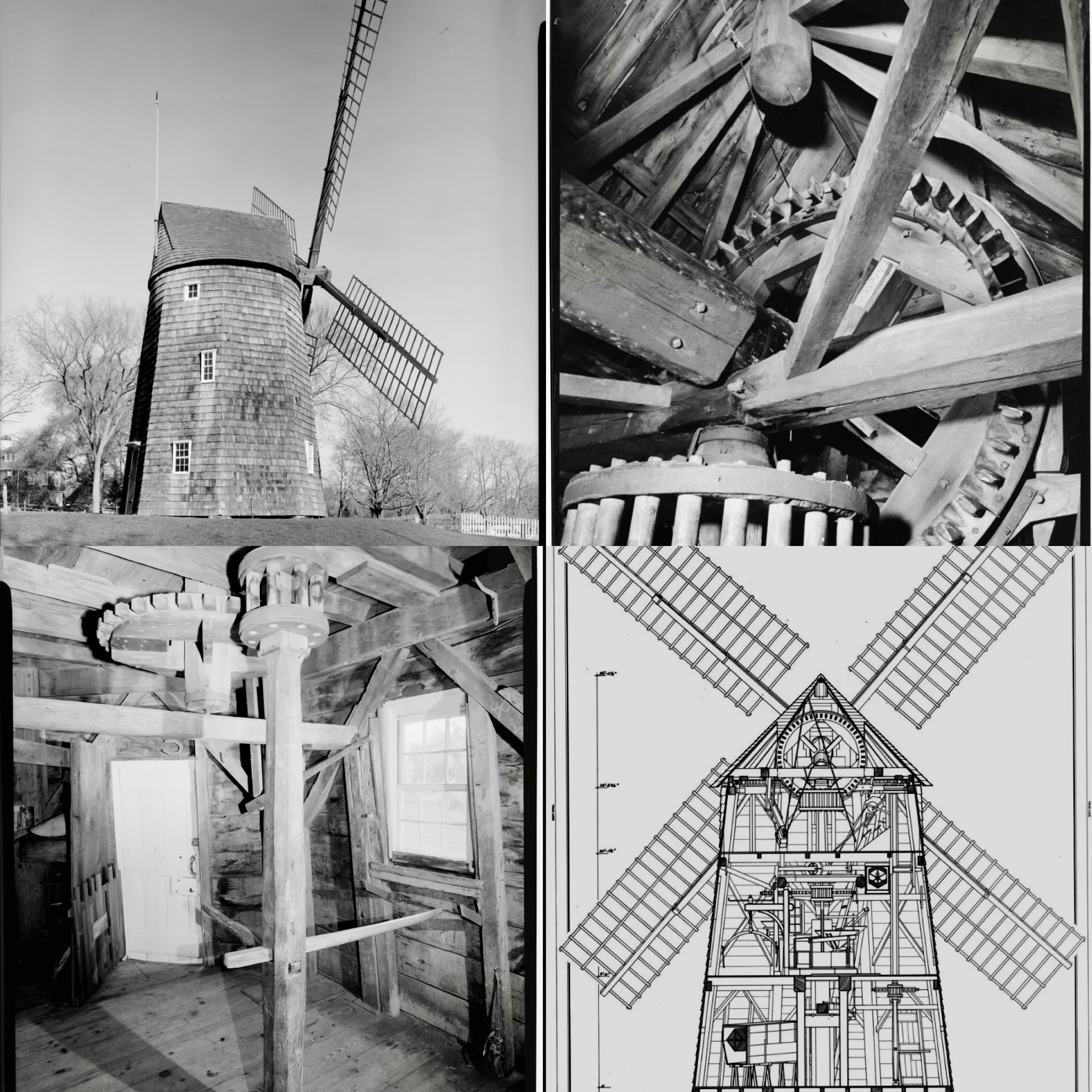
Hook Mill images courtesy of the Library of Congress / Historic American Buildings Survey (HABS).