Two New Mills in the Same Year — 1804 and the “Rift”
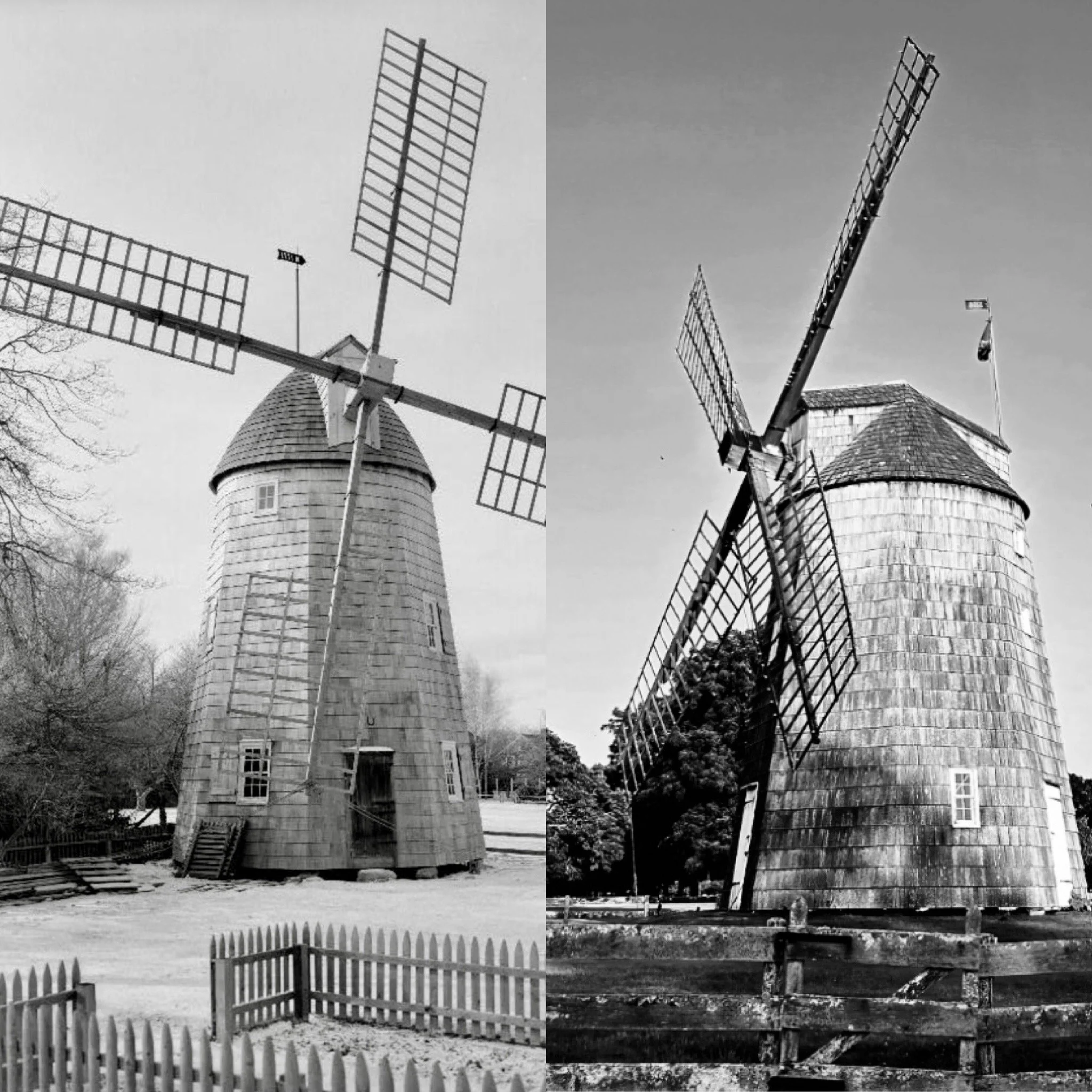
Mill Hill/Pantigo Mill and Gardiner Mill. Image courtesy of the Library of Congress / Historic American Buildings Survey (HABS).
#2 in Windmills Were Our Workplaces, a series
Introduction: She called it, carefully, a “rift.”
In the spring of 1804, two windmills rose across the village green in East Hampton—built at the same moment, by two millwrights, for competing partnerships. That alone tells a story. My mother, Sherrill Foster, found it fascinating.
This essay is part of a series drawn from her decades of research—her master’s thesis, lectures, and walking tours—through which she explored Long Island’s smock mills, the largest regional concentration in the country.
The two mills of 1804, she wrote, began as one: a planned partnership between Huntting Miller and John Lyon Gardiner. It fell apart when, as she put it, “a rift developed.” In talks to the DAR and others, she would add only that Miller was known for a short temper—perhaps not an explanation, but a telling detail.
What followed was a burst of mill construction at a moment of rising flour prices, expanding maritime trade, and deep local investment. Sherrill traced these forces through names—Dayton, Osborn, Hedges—ship captains, merchants, and landowners whose involvement reminds us that windmills were not purely agricultural. They provisioned ships and supplied regional and international markets. Their investors were part of a growing maritime economy centered on Sag Harbor, then emerging as a hub for coastal trade and, soon after, whaling.
I see the sailor in her here - her instinct to follow winds, ports, trade routes into unexpected places.
The Gardiner family particularly intrigued her. She followed their lineage from Lyon Gardiner, an early founder of East Hampton, to John Lyon Gardiner, one of the principal investors in the 1804 mill that bears the family name. He had unusually close ties to the Montaukett community, documenting their language in 1798 with Sachem George Pharaoh. (His grandfather, John Gardiner, spoke the Montaukett language, something Sherrill wrote about in the catalog for her 1976 Guild Hall exhibition Lifestyles of East Hampton.)
This matters to the mill story. Large construction projects drew on a wider local workforce than Dominy's shop alone, and it is possible that Montaukett men were among those who cut timber on Gardiners Island and raised the frame. Recent research confirms a free person of color, Isaac Plato (c.1767-1833) was among the construction crew.
The raising itself, Sherrill writes, must have been a striking scene – a community event in the late summer of 1804 with neighbors gathering to lift heavy timbers into place. The partnerships behind both mills extended back generations, often linking the same families through shared whaling ventures at sea and in local town offices.
She was equally interested in the millwrights themselves—each masters in their own right — noticing how they differed. She took care to name the skilled assistants involved in construction including Seth Parsons and David Sherrill – names that carried personal meaning for her. It must have given her some delight, knowing that she was related to them through both sides of her family – five generations back, both first cousins.
It was 1804, and these two mills reflect a moment when agriculture, commerce, maritime trade, and engineering were closely intertwined—and when the people building the future had, in many cases, been neighbors for generations.
Two New Mills in the Same Year — 1804 and the “Rift”
By Sherrill Foster, East Hampton Town Historian 2003-2007
Sherrill Foster wrote about East Hampton's windmills for more than twenty years, from her 1976 master's thesis through her columns and walking tours up to 2000. This post draws directly from that body of work, compiled and expanded by her daughter, Mary Foster Morgan.
In 1804, East Hampton witnessed something extraordinary: two new windmills rising within sight of each other across the Village Green.
One, built for Huntting Miller, replaced an earlier mill on Mill Hill. His millwright was Samuel Schellinger.
The other, financed by a consortium of eight businessmen including John Lyon Gardiner, rose on the opposite side of the commons, built by Nathaniel Dominy V.
An evolution in windmill engineering was underway. This is the story of that moment — two skilled millwrights, two state-of-the-art mills, and a “rift” at the center of it all.
Eastern Long Island’s eleven surviving wooden windmills form the largest group of historic windmills in the United States, with Cape Cod second. All share the classic smock mill form, and many retain original machinery. Five were built by Nathaniel Dominy V, three attributed to Samuel Schellinger, and others to local millwrights. Of the eleven, four stand in East Hampton — including the two 1804 mills, now owned by the Village.
That two mills rose at once in the summer of 1804 reflects three forces shaping the moment: economics, technology, and the men behind the mills.
Mill Economics: Why Mills Were Worth It
For roughly three decades—from the 1790s through the 1820s—eastern Long Island experienced a mill-building boom. It was driven by Atlantic-world trade. Wheat prices rose dramatically, and demand grew for flour and other exports: whale oil, beef, fish, and timber. These goods moved through trade networks linking Long Island to New York City, Boston, the Caribbean, and Europe.
Sailing ships made this trade efficient. New York, New London and Newport were key hubs, while prevailing westerlies and the Gulf Stream created favorable routes to Europe via Spain. Closer to home, Sag Harbor, Southampton, and East Hampton were already active ports, their networks built over generations through commerce, kinship, and political ties.
East Hampton’s trading history reached back to seventeenth-century merchants like Jacob Schellinger and Samuel Mulford, operating from Northwest Harbor, via Merchant’s Path. Montauk had long grazed livestock for export, whale oil had long been exported, and fine-milled flour became an increasingly popular addition.
Owning a mill required capital—often raised through partnerships—along with skilled, laborer and high-quality timber, much of it from Gardiners Island. A hired miller managed daily operations while local farmers supplied grain. With wind as a free and constant source of power, a well-sited mill could yield strong returns.
The mills are more properly called 'grist mills' because they grind grains into flour to make breads — grains such as wheat, rye, barley, oats and coarser grain into feed for livestock. Millers also used the stones to sharpen tools, shred rags for the early paper mills, press flaxseed into oil, and grate bones for paste and medicines.
Flour was essential: a family of five might consume 60 bushels of wheat a year, while whaling voyages required large stores of provisions to feed the crew. Demand was steady—and often high.
New High-Tech Mill Design: From Post Mill to Smock Mill
The boom was driven not only by economics but by a key engineering advance: the smock mill.
The earlier post mill takes its name from its large central post, The entire structure of the mill rotates to keep the sails facing the wind - a labor intensive process with the mill turned by hand, by horse, or by a long tailpole. They were typically small and operated with a single pair of stones.
The smock mill was a fundamental advance. Its fixed, eight-sided tower housed machinery, while only the roof-cap rotated to orient the sails. This allowed for larger, more stable structures with greater capacity – typically two sets of grinding stones, one for fine flour and one for coarser feed. It came to be named “smock” as it was shaped like the common coverall worn in the sixteenth century.
The design was safer, more efficient and better suited to changing winds. Millwrights developed different methods to turn the cap into the wind (“winding), including internal gearing (capstand winders), external tailpoles and in more advanced forms, automatic fantails.
The shape of the roof-cap differed -- and, like architectural styles, regional variations developed. Cape Cod mills often featured a distinctive conical cap.
Both post and smock mills were considered farm equipment – built to be movable, and raised on stone foundations for easier relocation and to keep interiors dry. Many of the surviving mills have been moved multiple times, complicating their histories.
The Two Millwrights
Who were the Dominys? The Dominy family were East Hampton’s most versatile craftsmen—clockmakers, cabinetmakers, surveyors, and millwrights. The family used the name Nathaniel for five successive generations. Their workshops on North Main Street, now documented at Winterthur Museum in Delaware, included a small ingenious forge for clockmaking and a larger woodworking shop for chairs, tables, chests, mirror frames, and the full-scale mill components they fabricated before hauling to construction sites.
Nathaniel Dominy IV (1739–1812), known as “the clockmaker,” had built and repaired post mills throughout his career. His son, Nathaniel Dominy V (1770–1852), became the leading millwright of his generation. A master cabinetmaker, he inherited from his father the precision of the clockmaker’s craft and an ethic of efficiency and safety, bringing these principles to the larger world of mill construction. Between 1795 and 1810, he built six wind-powered gristmills, three wind-powered sawmills, and a fulling mill. His surviving smock mills include the Gardiner and Hook mills in East Hampton, the mill at Sylvestor Manor on Shelter Island, and his first, the Gardiners Island mill.
Samuel Schellinger (c. 1765–1848) too had deep roots, going back five generations. His ancestor Jacobus Schellinger of East Hampton was a merchant of Amsterdam, Holland, who married Cornelia Melyn, daughter of the Patroon of Staten Island; the couple married in New Amsterdam. Based in Amagansett, Samuel Schellinger worked across a wide range of building trades—houses, barns, boats, and mills. Known in Sag Harbor as a skilled boatwright, he incorporated new “industrial age” technologies, such as cast iron, to smock-mill construction. He worked widely across Long Island and beyond, including Brooklyn, Block Island, and Nantucket. Three of the eleven remaining mills on the East End are attributed to him.
Though working within the same tradition, the two men approached their craft differently—differences that would become visible in the mills they built in 1804.
The First Smock Mill: Gardiners Island, 1795
Nine years earlier, John Lyon Gardiner had commissioned the first smock mill on Long Island. Built in 1795 by a young Nathaniel Dominy V, it still stands on its original site, in working order, painted white — cap, smock, and sweep in the English tradition – serving as a landmark for sailors in Gardiners Bay.
Gardiner knew the Dominys had the knowledge, skill, and experience to design and build the new high-technology smock mill needed for his Island farm. He hired the younger Nathaniel Dominy, age 25, as master millwright, who was assisted by his father “old Mr. N. Domine,” then 58, as Gardiner recorded in his notebook.
A crew of 34 men worked on the island, boarding on Gardiners Island from May 23 to November 8, 1795. The cost was $773.36. The millstones came from “Becket of Lyne” and cost $40, with freight of $6.27.
Gardiner’s notebook entry for May 23, 1795 — his account of raising the mill in his own words — is vivid:
May 23rd, Monday, 1795. In the morning began to raise my new mill with about 20 of my own and carpenters and eight more that came on. Raised her well before night and no one much hurt. She came together but needed no cutting, and her frame is good. She has some Mulberry and her trunnels are locust and mulberry. Nat. Domine Junr., David and Jonan Baker and their 3 prentis (i.e Lewis Baker, David Edwards and Jim Terry) and old Richard King framed her. Her frame is entirely new and she stands about 3 or 4 rods N/W/ of the old Petticoat mill.
With this structure on Gardiners Island, Dominy introduced the smock mill to the region: a fixed eight-sided shingled tower with a rotating roof-cap to adjust the sails to the wind. The mill originally had one pair of millstones; when Dominy rebuilt it in 1815, he added a second.
Dominy added an ingenious refinement to the rotating cap. Rather than have the cap turned externally with a tailpole—the traditional method, requiring a miller or a horse to work outside—Dominy employed an internal wheel-and-gear mechanism that allowed the miller to turn the heavy cap from within the mill. The principle was not necessarily his invention: internal capstan winders may have been known in England as early as the seventeenth century, and similar mechanisms were more common in Dutch windmills. But Dominy appears to have adapted and refined the system with the precision characteristic of his other work.
The system depended on tight-fitting, interlocking wooden parts that moved smoothly under load. This was precision woodworking of the kind practiced daily in the Dominy shop on North Main Street—brought to the scale of a working mill. The wooden gearing required scores of carefully fitted cogs and shafts, allowing a single miller to turn the cap from inside the mill with greater control and protection from the weather. Safety for the miller, efficiency for the mill.
Dominy also designed the roof cap in a low, rounded “dory” shape resembling an upturned hull. This distinctive dory cap would become Nathaniel Dominy V’s regional signature, while the safe and efficient internal gearing it housed became a hallmark of his smock mills. The Dominy family continued to use the system for decades, making it a distinctive feature of their mills.
Dominy’s innovation seems to have been less about inventing an entirely new technology than about bringing the precision of the clockmaker’s shop to the much larger scale of windmill construction.
The Gardiners Island mill established both this new smock-mill technology and the working relationship between Gardiner and Dominy — John Lyon and Nat — that would shape the events of 1804.
Two Millwrights, Two Entrepreneurs, Two Mills Facing the Green
In 1803, a consortium formed to build a new mill at Mill Hill. Among the investors were Huntting Miller and John Lyon Gardiner—both experienced, well-connected, and fully aware of the profits to be made.
A rift developed.
Miller was 51 and owned property near Mill Hill. John Lyon Gardiner, 33, held land on James Lane on the east side of the commons. Miller—known for a short temper—withdrew from the consortium and announced that he would build his own mill. The exact cause of the break was never recorded. Gardiner quickly reorganized, selling his partnership shares to Jeremiah Miller, Huntting’s older brother, and then forming a new partnership to build on his own property.
Two mills would rise instead of one.
Gardiner’s new consortium of eight East Hampton businessmen obtained the right to harvest timber on Gardiners Island for the new mill, and hired Nathaniel “Nat” Dominy V.
Miller hired Samuel Schellinger.
Construction began in March 1804 on Miller’s mill and in June on Gardiner’s. Both were completed by autumn.
The Huntting Miller (Pantigo) Mill (1804)
Samuel Schellinger built Miller’s mill on an artificial mound facing the Green. It was the third mill on that site since 1729. (An earlier grist mill had been owned by Miller Dayton, Jeremiah Osborne, and others, with Nathan Hedges as the miller.)
Schellinger, 39, began building in March 1804. He worked 83 days on the mill himself; his assistants – David Sherrill, 32, and the Raynor brothers from Sag Harbor (James, Richard, and Matthew) — contributed roughly 144 additional days of labor. The mill was completed in late summer. David Sherrill, who had apprenticed with the Dominys when he was 18, changed Miller for 35 days of work. His account book records that in June 1804 he was “framing the mill” and in August he was working on “the Mills running gear” – the mechanical heart of the mill. This could possibly mean what makes the mill run: the windshaft, the breakwheel, or other mechanical elements.
Schellinger’s design followed the smock-mill form and cap-turning – but using the reliable, traditional external tailpole to turn the cap and orient the sails. Simple, practical, and cost-effective. The mill’s tall roofline gave it a vertical, upward-reaching profile.
Huntting Miller (1753–1832) was a sixth-generation member of the prominent Miller–Hedges family of East Hampton, long active in town government, state politics, and agricultural and maritime trade.
Huntting Miller operated the mill as sole owner. Known as “Huntting Miller’s Mill,” it appears frequently in town records. He was excused from church to grind grain; on one occasion he hurriedly returned from cattle herding at Montauk —twenty-five miles away— when the wind rose suddenly and the mill had to be managed. Town records note it ground meal all night.
Miller's two daughters married locally into the Hedges family: Nancy to Col. David Hedges of East Hampton, and Mary to Wilkes Hedges of Sagaponack.
The mill passed to Huntting Miller's Sagaponack/Sag Harbor grandson, William Hedges (1803–1865), a captain in the New York State Infantry, on Miller's death in 1832 at age 79. In 1845, Capt. Hedges sold the building to his uncle, David A. Hedges, silversmith and New York Assemblyman who lived on Main Street in East Hampton. He was the first to move it off the Village Green, relocating it to Pantigo Road. Town records note the reason: the revolving sail-covered arms frightened horses on Main Street.
Milling continued to be a valuable business and in 1850 the mill was purchased by Felix Dominy, then fifty, the son of aging Nathaniel Dominy V. He moved it nearer to Hook Mill to operate the equipment together.
His son, Nathaniel Dominy VII, later acquired both mills and made repairs. The severe storm of 1879 twisted the Pantigo mill beyond repair. It never milled again, though it stood "down Pantigo" for sixty years.
In 1917, the mill changed hands again, purchased for preservation. Gustav Buek—a lithographer and friend of artist Thomas Moran—moved the structure to his summer estate, the historic Home Sweet Home. He restored both the mill and the saltbox house, furnishing them with period antiques in dedication to the playwright John Howard Payne. By 1920 Home Sweet Home was known as the John Howard Payne Memorial. In 1922, the Village of East Hampton purchased the property for a museum.
The mill itself has gone by many names along the way — Huntting Miller’s Mill, the Hedges Mill, the Pantigo Mill –- and relocated several times. It now stands at Home Sweet Home museum, across from “Mill Mill,” its original site on the west side of the Green.
The Gardiner Windmill (1804)
On the east side of the Green, at 12 James Lane stands the Gardiner Windmill, built by Nathaniel Dominy V, 34 for a partnership of eight investors.
Captain David Hedges, 35, held the largest share, while John Lyon Gardiner, 34, was the key organizer. Other partners included the miller Dayton Miller, 38, and Captain Jeremiah Osborne, 55, both of whom had owned earlier mills. (Capt. Hedges was the uncle of the Hedges who would later inherit the Pantigo Mill—not to be confused with a later Captain Hedges who skippered whaleboats to the South Seas and New Zealand in the 1840s out of Sag Harbor.)
The early miller was Nathan Hedges, then about twenty-one years old, a distant nephew. The mill replaced an earlier eighteenth-century one that had stood near, or on, the Gardiner home lot before 1804.
The Dominy construction record is unusually detailed, thanks largely to the accounts kept by Gardiner, who carefully documented the building of the windmill.
John Lyon Gardiner (1770-1816), whose mother was Jerusha Buell Gardiner, became the seventh Proprietor of Gardiners Island at the age of four. He married Sarah Griswold (granddaughter of Connecticut Governor Matthew Griswold) in 1803, and they raised five children. A scholar-naturalist and graduate of Princeton, he rebuilt the island into a productive farm after the devastation of the Revolutionary War, when a seven-year British occupation had ruined livestock, timber, and buildings. In 1798, he documented Montaukett vocabulary with the sachem George Pharoah. As a seventh-generation Gardiner, he maintained extensive networks of trade, family, and political connection across Connecticut and Massachusetts.
Framing began on June 11, 1804. Dominy worked roughly one hundred days on the construction himself; additional carpenters assisted in raising the tower and assembling the machinery, much of which had been prepared on Gardiners Island and shipped to East Hampton. His assistants included skilled carpenters Seth Parsons, 25, and Charles Mulford, about 40.
Gardiner’s daybook records that the oak timbers used to build the 1804 windmill were transported by boat from the island to a landing at Fire Place, and then hauled to the construction site for assembly.
The total cost was $1,320 in 1804 dollars—a significant investment. For comparison, the average Cape Cod–style house in East Hampton at that time cost about $270.
The Gardiner Windmill, like the Pantigo Mill, is a full smock mill, with a fixed eight-sided tower and two sets of grinding stones. Dominy used his internal gearing system, allowing the cap to be rotated from within the tower. He also incorporated refinements such as a rope-and-pulley system for reefing sails—improving both safety and efficiency.
The mill’s low, rounded dory cap gave it a broader, more grounded appearance in contrast to Schellinger’s taller design.
The Gardiner mill site included a miller’s house, still on the property today. It operated as a working mill throughout the nineteenth century and was purchased by the Village of East Hampton from Olney Mairs “Billy” Gardiner. It remains one of the few mills on the South Fork never to have been moved and retains its original machinery.
Two new mills!
What a grand sight that must have been in the autumn of 1804: two shingled mills facing each other across the Green, white sails turning. Their raising was a community event, as neighbors and relatives gathered to lift heavy timbers into place.
On Mill Hill stood Schellinger’s – tall and vertical, its tail pole intact. Across the way, stood Dominy’s – broader, slightly lower, firmly grounded with its dory cap.
Two craftsmen. Two approaches. A moment shaped by innovation, expanding maritime trade, and the shared world that defined East Hampton.
Sources
This compilation draws deeply on the research of my mother, Sherrill Foster. I have selected, organized, and supplemented her writings. Any errors or misinterpretations are mine.
Dominy family account books. Winterthur Museum, Winterthur, Delaware.
East Hampton Town records. East Hampton Town Clerk's Office, East Hampton, New York.
Foster, Sherrill. Walking tours and lectures on East Hampton windmills, 1996–2007. Notes and recordings in the possession of Mary Foster Morgan.
Foster, Sherrill, curator. Lifestyles of East Hampton, 1630–1976. Exhibition catalogue. East Hampton, NY: Guild Hall, 1976.
Gardiner, John Lyon. Notebooks and daybooks, 1795–1816. Long Island Collection, East Hampton Library, East Hampton, New York..
Hefner, Robert J. Windmills of Long Island. New York: W.W. Norton / Society for the Preservation of Long Island Antiquities, 1983.
Historic American Engineering Record (HAER). Recorded 1969. Washington, D.C.: U.S. Department of the Interior, National Park Service. Held by the Library of Congress, Prints and Photographs Division.
Library of Congress / Historic American Buildings Survey (HABS) images of Gardiner Mill and Mill Hill/Pantigo Mil. A program of the National Park Service established for the purpose of documenting historic places. Records consist of measured drawings, archival photographs, and written reports
Plain Sight Project, East Hampton. https://plainsightproject.org/
Rattray, Jeannette Edwards. East Hampton History, Including Genealogies of Early Families. East Hampton, NY: East Hampton Town, 1953.
Sherrill, David, Account Book 1770-1827, East Hampton Free Library, uncatalogued manuscript.
Winterthur Museum, Garden & Library, Dominy Collections, “Millwrights.”
Note: Dedication of Pantigo Windmill to Hugh King, 2023
In honor of the Town of East Hampton’s 375th Anniversary, Mayor Jerry Larsen and the Board of Trustees of the Inc. Village of East Hampton would like to dedicate the Pantigo Windmill to Hugh King, its long-time Museum Director and Village Historian. Mr. King is also the Town Crier and has made it his life’s mission to teach the history of our community.
With his theatrical storytelling, jovial disposition, and effortless humor, Hugh King has conjured living history for generations of students, museum visitors, and partakers of the Village’s celebrated walking tours. His strong commitment and dedication to our historic community ensures that the legacy of East Hampton lives on.
By dedicating the Pantigo Windmill to Hugh King and the Home Sweet Home Gardens to his wife, Loretta Orion, we guarantee their rightful place in East Hampton history.