Musters, Networks and Barter Before the Revolution
#6 in East Hampton and the Revolution — A Series
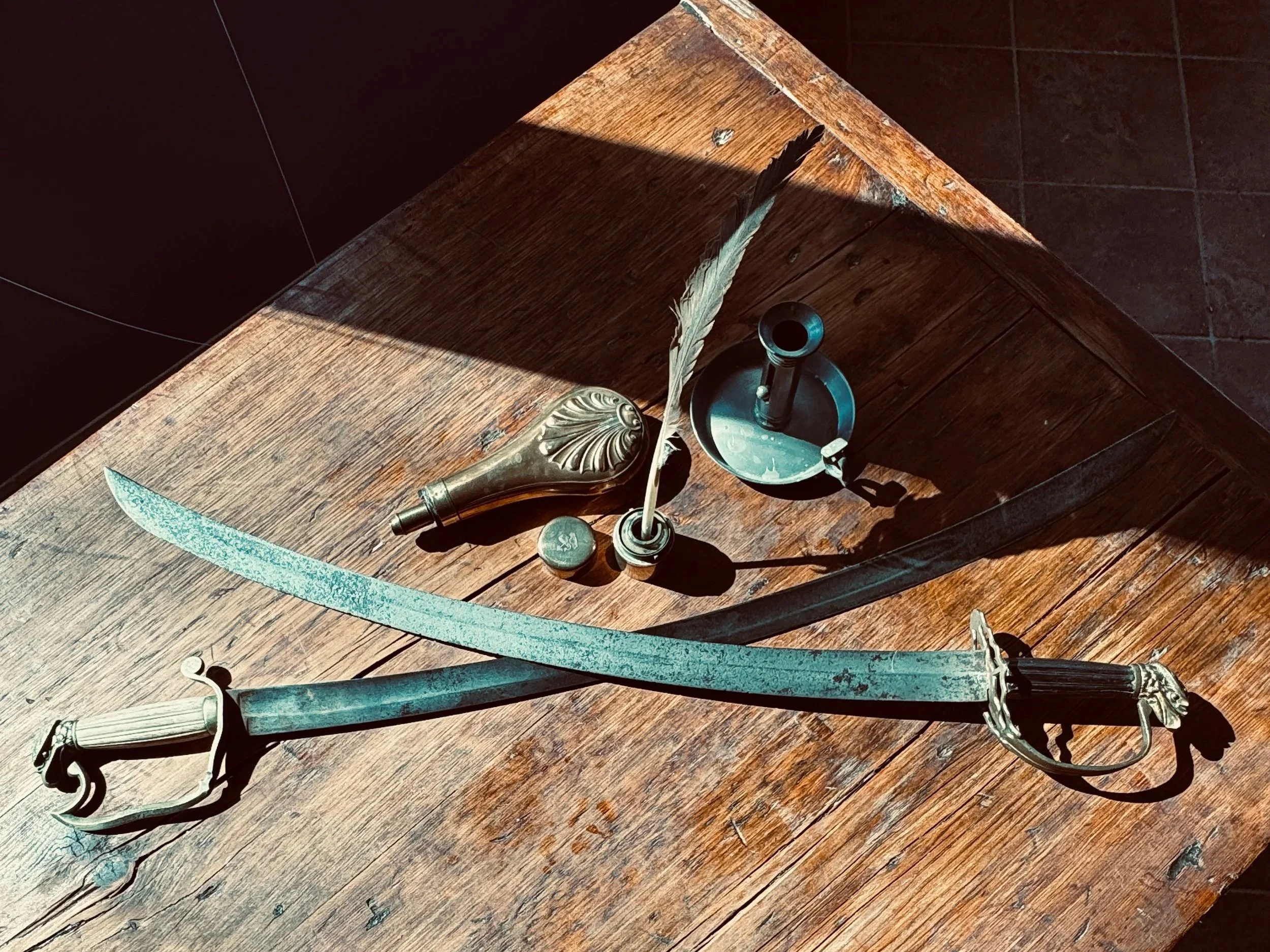
19c Eagle Head American swords, gunpowder flask, pewter candle holder, ink well.
Introduction: the Roots of Independence
After preparing four essays written by my mother, Sherrill Foster, on East Hampton during the Revolution, I discovered this piece and saw how it illuminates everything that came before.
My mother published this essay on June 29, 1994, timing it to appear just before the Fourth of July. But while the holiday celebrates 1776, Sherrill reaches back a full century earlier to the 1670s and 1680s, finding the roots of American independence not on the battlefield but in the mundane details of how people armed themselves, traded with neighbors, and gathered monthly on village greens.
This is classic Sherrill Foster—transforming newly published probate records into vivid social history. She's drawn to Thomas Cooper's transcription of Suffolk County court sessions because it gives her raw material: complete inventories of colonial households, unfiltered and exact. She counts: thirty-five guns, twenty-six swords, five pistols. She compares across towns. She questions, noting that those swords were a "remnant of Medieval armor…almost useless in the type of fighting actually taking place in the Colonies."
She notes that every male from 16 to 60 was required to join the militia and describes their monthly training—men marching and shooting volleys, drinking flip heated with a loggerhead at Baker's Tavern.
From an inventory after the death of Obadiah Palmer, a young upholsterer who drowned off East Hampton in 1680/81, she reconstructs an entire life: different weight cloths for reupholstering furniture, gilt buckles, forty people who owed him money in a complex web of barter and debt.
What makes this essay quintessentially my mother's work is her insistence that we understand history through objects and documents, not romance. She shows us how to read probate records, what they reveal about social networks in interconnected coastal towns. Sherrill wasn't looking for interpretation but for primary sources she could analyze herself. The past she recovers is one of economic interdependence and the details of daily survival in 17th-century Long Island.
Reading this essay after immersing myself in her Revolutionary War writing, I see the patterns persisting a century later: militia musters on village greens, trading networks linking Long Island to Connecticut and beyond, systems of credit and barter. This is the foundation upon which the Revolutionary story rests. It's fitting that she published it for the Fourth of July, reaching back to show how independence was built not just in 1776, but across generations of practical, armed, interconnected colonial life.
My mother didn't title her June 29, 1994 article, but I have: "Musters, Networks and Barter Before the Revolution”"—because that's exactly what it shows us.
Musters, Networks and Barter Before the Revolution
#6 in East Hampton and the Revolution — A Series
By Sherrill Foster, East Hampton Town Historian 2003-2007
A series based on essays from Around the Green,The Independent; this one first appeared in June 29, 1994. Updated by Mary Foster Morgan, 2026.
In honor of the great American day of Independence, this article will be about guns and swords and militia training day in the 1600s.
In a recently published book, Records of the Court of Sessions of Suffolk County in the Province of New York, 1670-1688 by Thomas W. Cooper, the complete transcripts of the wills, probates etc. including the Indian deeds for Montauk are printed exactly as written on the original pages not in the Suffolk County Archives. It covers the four towns in Suffolk at that time: Southold, Southampton, East Hampton, and Huntington. These towns were all closely connected by boat with the Connecticut shore towns, Newport and Boston. Many of the residents were related, having descended from the English settlers who came in the Great Migration of 1630-33.
Train Bands and Weapons
In looking through these 128 probate lists and the wills, one is struck by the number of weapons listed. Every male from 16 to 60 was required to turn out for the monthly "training day," the train band or militia unit for each village. The day was a big social time: On the village green, the men marched and counter marched, shot volleys with their muskets, and drank lots of rum in the local tavern. In East Hampton this was Baker's Tavern (now at 181 Main Street). The rum would have been brought up from Barbados in the Mulford or Schellinger trading vessels.
Flip was the popular drink. It was hot, made from beer and rum or brandy, in a tall glass with a long-handled iron, called a loggerhead, warmed in the fire and thrust in to the drink. This both heated the drink and brought it to a foam. It doesn't take much imagination to see that this was all great fun.
In the four Suffolk towns there were 35 "gun/old gun," 16 "musket/old musket," 26 sword (some with belt), rapier, one "cutlash," three bandoleers and three powder horns, five pistols, one lance, and an ambiguous "ammunition" of 11 items. The difference between "old gun" and "gun," "musket" and "old musket" may have been only in the minds of the persons taking the inventory.
Southampton had the most number of guns, 19, with five pistols in Easthampton and Southold the most (7) muskets.
The number of swords are interesting, 26. This remnant of Medieval armor would be almost useless in the type of fighting actually taking place in the Colonies. Two men in East Hampton had swords, 15 in Southampton, five in Southold, and four in Huntington.
The widow Alice Stanborough had one "ould gun," whereas Joshua Garlick Jr. had a gun and a sword. Isaak Hedges had a gun and cutlash (?)
Obediah Palmer
Obediah Palmer had a rapier, a "gunn" and 2 clocks, a powder horn and one lance. He also had four "Heele spurs." Was that for riding? Many of the men had saddles.
Palmer drowned off the coast of East Hampton in the winter of 1680/81. He was an unmarried young man, and died without a will. His inventory was taken by his brothers, John Palmer and William Barnes. William Barnes is presumably a brother-in-law, his wife a sister of Obadiah Palmer. However, no William Barnes of the proper age is found in the main source of genealogical information, East Hampton History and Genealogies, by Jeannette Edwards Rattray of 1952.
The Palmers are not an East Hampton family, yet Obadiah Palmer's inventory was taken in East Hampton. There is a Palmer family in Stonington, Conn., related to a merchant in London, Abraham Palmer. The Barnes family may also have been from a Connecticut shore town, the two men coming over by boat to wind up Obadiah's estate.
From Obadiah's inventory and the accounting of his books, we can assume that he was an upholsterer, that he reupholstered people's furniture. Among his effects are 139 yards of "Ossenburgs" (a heavy coarse cotton in a plain weave used for sacking), "2 bunches of Galloon," the decorating tape for furniture, and about three yards of blue "lining." He also had four yards of serbe [serge: durable twilled woolen fabric for clothing and upholstery], some cotton ribbon, two yards of girt welt, two pairs of scissors, one book, one ink horn, six gimletts for boring small holes in wood, and six pieces of sealing wax.
Obediah had almost no cooking or hearth utensils. He had three knives for eating (forks were not yet introduced and barely spoons). He had two candlesticks and one bed and "coverlaid." His clothing consisted of one pair of "trowsers" two coats, one "hatt," four pairs of gloves, two pair stockings, and one pair of shoes. He had two gilt buckles and five pair "shoo" buckles. Obediah's personal items were two combs, a razor and "hoone."
Forty people owed Obediah money, sums ranging from 3 pounds 10 to as low as 1 shilling 1 pence. Margaret Hobart owed him 4 shilling 10 at the end of 1680. Osbornes, Brooks, Mulfords, Dimons, and Strattons, among others, all owed him for work done. He undoubtedly was planning on the extensive barter system to get his food, wood for his hearth, and other necessities for life in 17th-century East Hampton.
This compilation of records by Thomas Cooper includes the Indian Deeds to Montauk (the first time they have been publicly printed). It can be obtained at the Weathervane Shop of the Suffolk County Historical Society in Riverhead.
Endnote:
Sherrill Foster illustrated the original article with a photograph of a powder horn from the collection of the Connecticut Historical Society in Hartford, Conn. Her caption: Although made a century later in 1762, it shows the romantic influence of swords.
Cooper, Thomas W., transcriber. The Records of the Court of Sessions of Suffolk County in the Province of New York, 1670-1688. Bowie, MD: Heritage Books, 1993.