Two Sherrill Brothers Serving in the Revolution: What Life Was Like
#7 in East Hampton and the Revolution — A Series
Introduction: A Deed Starts a Discovery
It seems like I always knew about Lt. Abraham Sherrill, my fourth great-grandfather.
I first remember hearing about him when visiting my grandparents at their farm on Fireplace Road—the farm Abraham had bought from the Conklings in 1792, 19 acres with a house, barn, and shop. The framed deed hung on the entryway wall, a tangible link to the past.
We knew he'd resigned his commission as lieutenant in early 1800, and within the month married Anna Huntting, his "childhood sweetheart" according to my grandmother. They raised three boys together — on the Conkling, now Sherrill, farm then passed down from father to son for five generations to my grandfather.
But his Revolutionary War service was a mystery. When did he join? What did he do? If he enlisted in 1775 like others from East Hampton, he would have been just twenty-one. Then he served—somehow, somewhere—until resigning his commission in 1800 at age forty-six.
From 1775 to 1800 that's twenty-five years—but what was he doing all that time? What was his life like?
And his older brother Recompence, thirteen years his senior, already married with young children—what was he doing during the seven years of British occupation 1775-1782?
It's still a bit of a puzzle, but I've found pieces in Mather's Refugees and in Abraham's own pension application from 1832. This is what I've learned so far about two brothers, serving one cause, two very different ways.
Two Sherrill Brothers Serving in the Revolution: What Life Was Like
Here's what the records reveal about my 4th great-grandfather Abraham and his brother Recompence during the Revolution:
Abraham Sherrill
May 1775: Signed Association, age 21
June 1775: Enlisted in the Third Regiment Continental Line under Col. James Clinton, Capt. John Hulbert
Summer 1775: Stationed at Montauk for four weeks, then sent to Ticonderoga to escort 175 prisoners to Old Canaan, Connecticut
Fall 1775-March 1776: Returned to Fort Constitution, served as express/messenger to Gen. James Clinton under Col. Henry B. Livingston, Lt. John Davis, and Ensign Sylvanus Conklin
April 1776-December 1776: Re-enlisted and served under Capt. John Davis and Lt. Col. Livingston, Third New York Regiment
May-October 1777: another 6 months of service ending October 17, at Burgoyne's surrender at Saratoga.
1789: Appointed ensign in Lt. Col. Benjamin Huntting's Regiment, eventually rising to lieutenant before resigning in 1800.
Recompence Sherrill
Age 34 in 1775, married to Naomi Burnham since 1768
Had children including: Naomi (age 6), Seth (age 4), David (age 3), and a baby Nathaniel born July 28, 1775 who died just 5 days later
May 1775: Signed the Association with his father, brother Abraham, and uncle Jacob
September 1776: After the Battle of Long Island, evacuated East Hampton by ship—first sailing with Captain Elijah Mason to Chester, Connecticut
Was himself a ship captain by 1776, transporting other refugees from Long Island to Connecticut
By 1787: Had returned to East Hampton
All Signed the Association
When the Sherrill brothers signed the Association in Easthampton on May 5, 1775, they stood with their father Recompence Sr. and uncle Jacob—four men from one family pledging their lives to the American cause.
But the Revolution the two Sherrill brothers experienced would unfold very differently. Abraham entered military service as a courier and soldier in the Northern campaigns. His older brother Recompence, already a husband and father, fought the war in another way — transporting refugees across Long Island Sound through occupied waters after the British conquest of Long Island.
Every male in the Town capable of bearing arms stood with them that day. Just ten days after the "shot heard 'round the world" at Lexington and Concord, Easthampton had voted to adopt New York's Articles of General Association—a loyalty pledge whose signers vowed to preserve:
our Constitution and oppos[e] the execution of the several arbitrary and oppressive acts of the British Parliament, until reconciliation between Great Britain and America on Constitutional Principles (which we most ardently desire) can be obtained.
It was a signed protest against British misrule that bound them to assist, in whatever way they might, the cause of American independence against oppressive acts.
My grandfather Abraham had just turned twenty-one that April. Not married, he was living at home with his parents and his three younger siblings—Stephen 17, Sarah 16, and Puah 15. Most likely he was helping his father on their Town Street farm.
Abraham Goes to War (1775–1776)
In June, like many others from Easthampton and Southampton, Abraham enlisted in the Third Regiment Continental Line under Colonel James Clinton. He joined the company his uncle Jacob Sherrill had joined in March, organized by Captain John Hulbert, a wealthy Sag Harbor/Southampton merchant.
By July, Abraham was stationed at Montauk to observe and report on British ships entering local waters. In August he was sent north to Ticonderoga where he helped escort 175 British prisoners to Old Canaan, Connecticut Colony.
Surviving military records help reconstruct Abraham’s movements during the war, especially those connected to his officers: James Clinton, John Hulbert, John Davis and Benjamin Huntting.
Under Col. James Clinton prisoners captured from the May raid on Fort Ticonderoga were transported to various places. Local historians note that Capt. Hulbert's company escorted their prisoners all the way to Philadelphia, where the company was presented before the Continental Congress. Reports spread that Hulbert's march had done much to lift morale and speed enlistments in the Continental Army.
While Abraham likely was not in the Hulbert march to Philadelphia, he surely heard about his fellow Ticonderoga-patriots being presented before Congress.
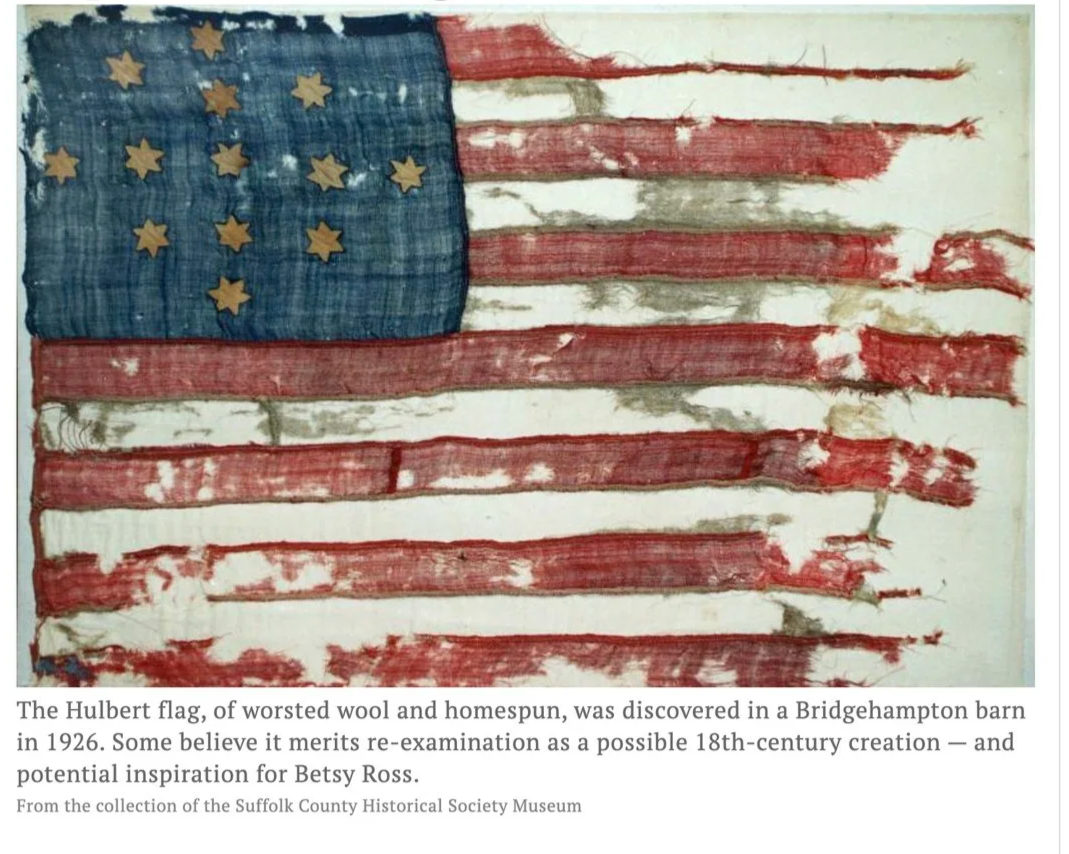
And I can't help but wonder what he knew about the now-famous "Hulbert Flag" — a rare early Stars and Stripes design. It was held high on the march to Philadelphia. Lost and then discovered in 1926 wrapped in Hulbert's military papers in a Sag Harbor barn rafters, it is now in the collection of the Suffolk County Historical Society, one of the oldest known examples of the design.
By fall of 1775 Abraham was at Fort Constitution near Fishkill on the Hudson. He was serving as express or messenger to now General James Clinton and Lt. John Davis. He must have been a trusted and able horseman as messenger is dangerous work that required riding alone through contested territory carrying vital communications. Abraham surely knew John Davis. Davis later rose to major before dying 1781, age 42, aboard the infamous British prison ship Jersey in Brooklyn harbor. Major Davis was married to Abraham’s first cousin Puah Parsons Davis (named after his mother, her “Aunt Puah.”)
In March 1776 Abraham’s military contract expired and he returned to his parents’ home. Then immediately reenlisted. From April to December 1776 he served again under Capt. John Davis and Lt. Col. Henry B. Livingston, Third New York Regiment.
From what I could piece together, Abraham may not have returned to Ticonderoga with Livingston’s regiment that April. Instead, it's likely he continued serving as an express rider under Capt. Davis on eastern Long Island, aiding communications involving coastal reconnaissance, British ship sightings, militia coordination, and Loyalist activity. Carrying communications between Patriot outposts was vital as British control tightened after the Battle of Long Island. Men familiar with local roads, harbors, and families were invaluable in such work and many transitioned from coastal messenger to military courier.
Recompence and the Fall of Long Island (1776)
While Abraham had enlisted, older brother Recompence remained in Easthampton through the summer of 1776. He and Naomi were caring for small children at home: six-year-old Naomi, four-year-old Seth, and little David, not yet three. That July, Naomi gave birth to a son they named Nathaniel, who lived only five days.
Then came August 27, 1776 and the catastrophic Battle of Long Island. It ended quickly, when Washington's forces — roughly 10,000 men — were outmaneuvered and nearly surrounded by 20,000 British and Hessian troops. Through tactical brilliance and favorable weather — fog and rain that concealed their movements — Washington was able to move his entire army across to Manhattan in a nighttime retreat that saved the Continental cause. He had lost the battle but preserved his army, and with it, the Revolution.
Long Island, however, was lost. New York and Long Island were immediately occupied by the British.
Acting quickly, the Provincial Congress issued urgent evacuation orders: get families, enslaved workers, livestock, and grain across the Sound to Connecticut. The convention would pay transportation costs, but the window for escape was closing as British forces tightened their control.
For the Sherrill brothers, this crisis demanded different responses. Abraham was already in service, carrying messages for General Clinton. But Recompence, at home with Naomi and their young children – Naomi, Seth, David and grieving the loss of baby Nathaniel — saw his service take a different path: he was a skilled ship captain, and his neighbors needed transport to safety.
As with his brother's service, this too was dangerous work—piloting vessels across the Long Island Sound, possibly in darkness, navigating away from British patrols.
At Sag Harbor a new dock had recently been built, which became a major departure pier. The first vessel to leave with refugees was captained by Zebulon Cooper of Southampton, who on September 2, 1776, began moving residents to Saybrook in his 60-ton vessel. Over 4,000 Long Islanders became refugees, leaving their homes with whatever they could carry or transport. The scale of the refugee crisis was massive: an exodus triggered directly by the August battle's outcome. Long Island was to be occupied by the British Army until the war's end in 1783.
The Mather's Refugees account books tell the story of Recompence's role (Mather notes: "It took some time to translate Rich Shary into Capt. Recompence Sherrill"): On September 1, 1776, Captain Recompence Sherrill transported "1 Lode Goods I Person" from Long Island to Saybrook—passenger Hezekiah Bower and his household.
By October, “Shary” was making the longer run to Hartford, carrying Judge Abraham Miller's household goods and provisions, along with goods for Jeremiah Conklin. His young son David, just four years old, made at least one of these voyages with his father—a memory that would stay with him into old age, when he told his own children about going "to Hartford in a vessel, with his father after the battle of Long Island."
Whether Recompence himself was technically a "refugee" became a matter of family debate generations later—a debate that reveals how complicated life was under occupation. His great-great-grandson Hiram Sherrill insisted he was not, pointing to evidence that Recompence was "residing in East Hampton at the time, probably with his family"—even arrested once by the British for giving food to a soldier, then immediately discharged. "Judging from the character of the man," Hiram wrote, "it would take something more than a British soldier to cause him to abandon his home. He was a large-hearted, generous and liberal man."
Yet the shipping records suggest a more complex story: a ship captain who remained in occupied Easthampton while repeatedly crossing the Sound to transport refugees—navigating British patrols and dangerous waters to bring families and their possessions to safety in Connecticut. Recompence operated in that gray zone of the occupation, neither purely refugee nor purely resister, but something more nuanced: a man who stayed connected to his home while helping others escape. The Mather records are only for September-October 1776. Did he continue transport work throughout the occupation, or was this just the initial exodus?
By early 1777, the first months of the long British occupation, both Sherrill brothers were in Easthampton. Recompence was with his family and Abraham with his parents and younger siblings: Sarah (who would soon marry Edward Conkling), Stephen and Puah.
But not for long. In May Abraham reenlisted again for another 6 months, his service ending October 17, 1777. When Abraham applied for his pension at age seventy-eight he recalled it as “the day of Burgogne’s surrender.”
The brother’s wartime roles had settled into a pattern: Abraham moving north with the army, Recompance navigating the uncertainties of occupied Easthampton.
Saratoga and Occupation (1777–1783)
The Northern campaign transformed the war.
Abraham was there, May to October 1777, with the New York Line regiment that was deeply engaged in activities to defeat Burgoyne's invasion from Canada.
After the Patriot victory at Bennington in August 1777, New England militia flooded into the region, and by October Burgoyne’s army was surrounded at Saratoga. If Abraham was serving as an express rider, as his earlier service suggests, he had the experience that the Northern Army needed: someone who knew how to move fast through contested territory, carry concealed dispatches, and connect the decentralized network of commanders and outposts.
Burgoyne’s surrender changed the course of the war. News spread quickly through the colonies that a British army had surrendered to American forces – something many had thought impossible only two years earlier. More colonists joined the cause. It convinced France to formally ally with the United States and transformed the conflict into a wider international war. On October 17 Burgoyne surrendered his army.
Abraham headed home. Home to Easthampton where his parents, sisters and brother had been for all the hardships that residents faced. The British forces that occupied Long Island subjected residents to constant harassment, rampant looting, and seizure of property. Troops commandeered homes, food, and livestock. Families scattered and separated as many fled to Connecticut.
And there were divided loyalties. While many residents were patriots, the occupation forced them into silence, and some were forced to support the British.
Recompence had helped many families take refuge across the Sound. When would it end? The British did not leave until after the war finally ended, in November 1783, Evacuation Day.
Was Recompence involved in some of the increasingly bold Patriot operations, many that relied on secret intelligence networks across the Sound? The Meigs Raid of May 1777 — still talked about today — was one. Lt. Col. Jonathan Meigs led a surprise night raid on Sag Harbor after crossing from Connecticut. Over 200 continental soldiers, some from Easthampton rowed in 13 whaleboats across Long Island Sound in the cover of darkness reaching Sag Harbor after midnight. They hid their boats in the woods, and set off on foot to destroy British ships at anchor. Twelve British brigs were burned. The Americans suffered no casualties. The British lost 6 men and had 90 taken prisoner. Men like Recompence — who knew those waters intimately and had already proven willing to risk British patrols — were the kind of local assets such operations relied on, whether or not their names appear in any record.
In those occupation years after October 1777, Abraham stayed with his aging parents, helping them and his younger siblings stay safe and manage the farm. Their homelot was just three houses away from The Huntting Inn, a neutral haven during the occupation where British officers met. Did Abraham stay involved in military service, perhaps always ready to be called up as needed?
News of the British defeats of 1780-81 in the South would have traveled through hidden networks, signaling that the British “Southern Strategy” was failing. Residents would have noticed fewer British warships patrolling the Sound, diverted to deal with the French Navy near the Chesapeake. Still, Long Island remained under enemy control. American and French forces controlled the eastern seaboard north of New York all the way to Nova Scotia, which left Gardiner’s Bay as the last safe stopping-off point for British ships.
War’s End: Two Brothers in the New Republic
At war's end, 1783, both brothers were in Easthampton. Recompence returned fully to his life, his farm, raising his family – the fifth generation of Sherrills. When Clinton Academy was being built in 1784, he was one of its early founding contributors, and his son David, became a student.
Abraham was home, too, helping his parents and younger siblings tend the farm in town. His father lived to see the Treaty of Paris signed, dying in 1786 at age 80. His mother Puah would live on another dozen years to age 86 in 1798, but would see her two youngest children die – Stephen, 30, drowned swimming in the ocean with a friend in 1788 and Puah, 32, would die in 1792. Abraham was there to support his mother through all these sorrows.
Abraham had stayed in the local militia, had been appointed ensign in 1789 in Lt. Colonel Benjamin Huntting's Regiment, eventually rising to lieutenant. His later militia career represents a type of continuity – from wartime courier and campaign soldier to a local militia officer in the early republic. It was needed local defence preparedness, as the new United States still feared a British return, frontier conflicts, maritime threats and even internal unrest. The militia system remained the backbone of emergency defense, mainly staffed by former soldiers.
It was the year of his youngest sister’s death, 1792, when Abraham began putting down roots for his own life. He bought the Conkling farm near the Dominy farm north of town. His older brother Recompence would inherit the house in town from their mother and eventually give it to his son David.
Did Lt. Col. Benjamin Huntting play a role in Abraham’s next step? Abraham certainly knew him well — from Sag Harbor, nearly his same age, his commanding officer in the militia. Benjamin was also first cousin to Anna Huntting, the woman he would marry.
At forty-six he was finally able to establish his own home, like his brother had started at twenty-three. The war had intervened in everything – delaying marriages, scattering families, destroying home life.
On April 27, 1800, a month after resigning his commission, Abraham and Anna married. Together they would raise three boys on the former Conkling, now Sherrill, farm, a half-mile walk north from the Huntting Inn.
As of this writing I have not yet found evidence of the Sherrill brothers coordinating during the war years. Their later relationship suggests an ongoing closeness.
When Abraham and Anna settled on the farm in 1800, the Dominy workshop was just across the way – and familiar to Abraham. Nathaniel Dominy IV had supplied bullets for the Patriot cause while Abraham was serving in the field. Over the next decades Abraham would seek out Dominy craftsmanship and expertise — beds, a child’s chair, a school desk, farm equipment and even house renovation — a continuation of ties forged not only as neighbors but as veterans.
Abraham, my 4th great-grandfather, lived to be 90, and is beginning to come into focus for me: not only as a loyal Patriot and property owner, but also as a devoted son, husband, and father, deeply rooted in family, community, and early American values.
I didn’t know him, of course, but you could almost feel his presence in the house — his house, later my grandfather’s — still filled with Dominy furniture across five generations. That story belongs to another essay.
The deed on my grandparents’ wall began the unfolding of this family history: two brothers belonging to a time, a place, and a cause, yet choosing very different paths. One served primarily as soldier and courier, the other as mariner and protector of civilians.
Both risked their lives, weathered the long uncertainty of war, the hardships of occupation, then returned home to help build the new republic — a democracy that became their legacy to us.
Sources and Notes:
Frederic Gregory Mather, The Refugees of 1776 from Long Island to Connecticut (Albany, NY: 1913)
Charles Hitchcock Sherrill, The Sherrill Genealogy (Louis Effingham de Forest, 1932)
Abraham Sherrill testified on September 15, 1832, in his application for a pension.
Biographical details on James Clinton, John Hulbert, John Davis and Benjamin Huntting drawn from standard military reference sources and regimental histories of the Third New York Regiment.