Occupation, Not Submission: New Research on Nathaniel Dominy IV, Patriot and “Holding the Flank”
#8 in East Hampton and the Revolution — A Series
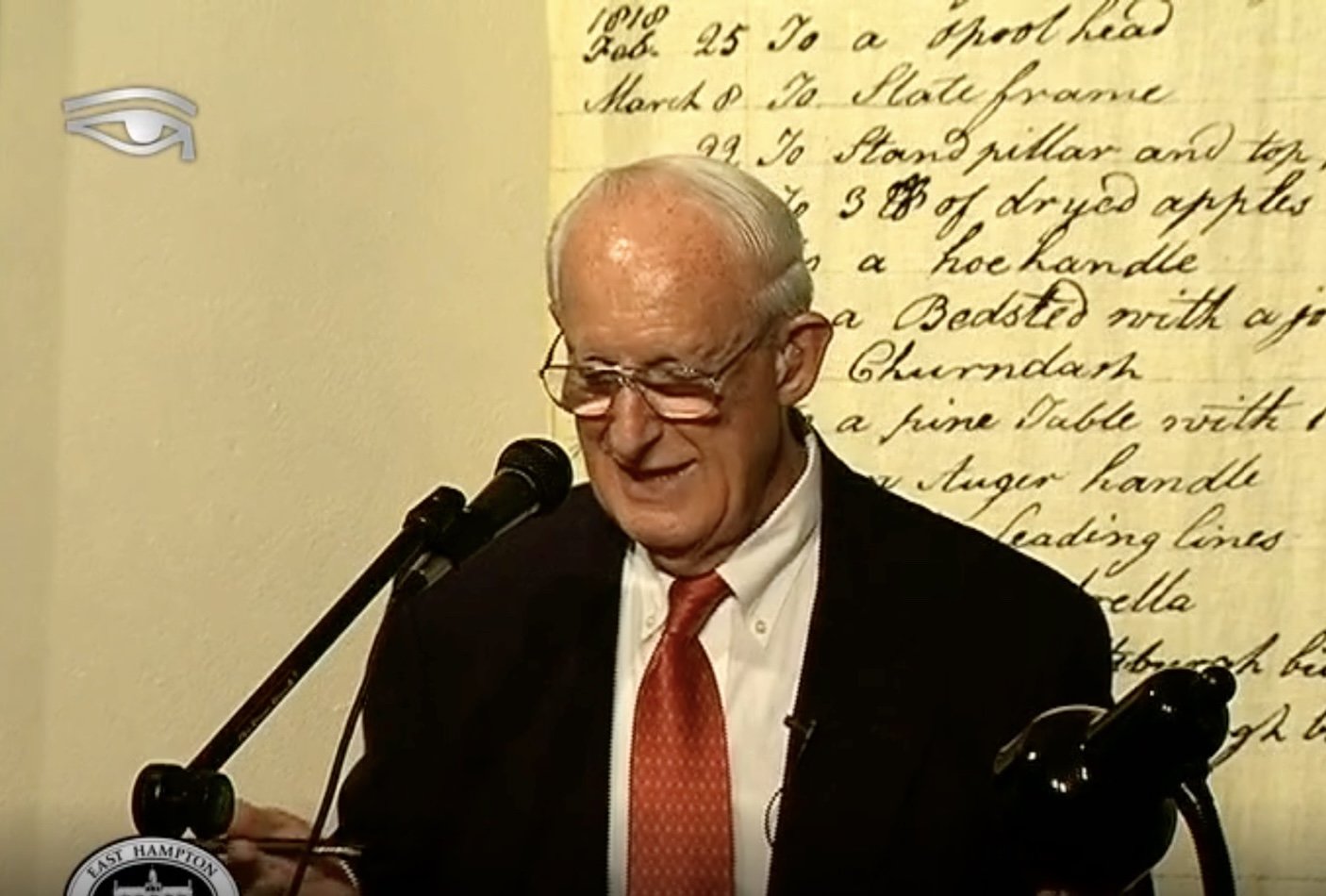
Charles Hummel, Curator Emeritus at Winterthur Museum, at the East Hampton Historical Society
Introduction: A Child’s Chair Started the Conversation
Six of the essays in this series are my mother's. The seventh was mine — the Sherrill brothers, the records I found in Mather's Refugees, the puzzle of two brothers serving one cause two different ways.
This one continues that thread, but it began, unexpectedly, with a child’s chair.
I went to Middletown, Delaware in November 2023 with a notebook full of questions about furniture — specifically, the pieces Nathaniel Dominy V made for my 4th great-grandfather Lt. Abraham Sherrill after the war. Charles Hummel, Curator Emeritus at Winterthur Museum and the nation's leading authority on the Dominy craftsmen, had known my mother for years and invited me to visit. I thought I was going to learn more about a child’s chair I inherited. It was the first piece of furniture Abraham commissioned from the Dominys – April 25, 1801. Was it unique? (Yes.)
But what Charlie most wanted to share was his recent research into what a Dominy and a Sherrill ancestor had actually done during the Revolution — and how East Hampton needed to update its story of what happened 250 years ago.
Sometimes historical discoveries come unexpectedly. My mother knew that. I spent one afternoon in a scholar's study and came home with something she would have loved: an East Hampton story hiding in plain sight, waiting for someone to ask the right question.
Occupation, Not Submission
New Research on Nathaniel Dominy IV, Patriot and “Holding the Flank”
Essay by Mary Foster Morgan from a conversation with Charles F. Hummel, November 2023
Conversations with Charles Hummel, Dominy Scholar
Charles Hummel had invited me to come visit him, anytime, he said. He had retired and was living with his wife, their son and family in Middletown, Delaware. So Tom and I went to visit. I had a notebook with a list of questions about Dominy furniture commissioned by my 4th great-grandfather, Lt. Abraham Sherrill.
Mr. Hummel, Curator Emeritus at Winterthur Museum and the nation's leading authority on the Dominy craftsmen of East Hampton, had known my mother, Sherrill Foster, for years, and was a contributor to her seminal conference in 1992, Maidstone Revisited. He had kindly invited us to visit, eager to share recent research—a talk he had given to a local historical society about Dominy's involvement as a patriot in the Revolutionary War, titled "Nathaniel Dominy IV: Patriot, Clockmaker, Watch Repairer."
As we settled into his office, Charlie got straight to the point. He wanted me to know that members of my family—including an Abraham Sherrill (a great-uncle, my 4th great-grandfather’s uncle)—had served alongside Nathaniel Dominy IV in Captain Ezekiel Mulford's Twelfth Company of local militia during the 1776 Battle of Long Island.
For generations, East Hampton history held that Mulford's company was "turned back" that August day—that the battle was lost and they were sent home. But according to Mr. Hummel's research, there is a far more exciting, heroic, and consequential story to tell.
"Mulford wasn't turned back," Charlie said. "If it hadn't been for Mulford and the platoon that they joined, Washington might not have gotten away."
The Evidence of Resistance, not Submission
For his talk on Nathaniel Dominy IV as patriot, Mr. Hummel had researched Dominy account books, tools, and other material culture. What he found painted a picture of sustained resistance throughout the war years.
Dominy's account books show weapons repair lists beginning in 1774. He used his forge to create and repair weapons—muskets, rifles, bayonets—for the militia company and later for neighbors during the occupation years. But the most extraordinary artifacts are the bullet molds.
Metal molds for casting bullets, with "N. Dominy 1779" cast directly into the metal—three years into the British occupation of Long Island. For Dominy, this was his statement that occupation did not mean submission, a message to his militia compatriots: we remained armed and ready.
The watch registers reveal another act of defiance: a British officer's unpaid debt for watch repair, recorded but never collected. Charlie took special pleasure in pointing out what Dominy had written in the ledger—the debt not honored, and beside the officer's name, "Transient"—his pointed reminder that the occupation would not last.
1775: Before the Battle
Before the Battle of Long Island even began, East Hampton families were already playing an important role in the Revolution. When the royal governors ordered lists compiled of all males capable of bearing arms, Captain Ezekiel Mulford had already organized a local militia of approximately sixteen men. Among them were Nathaniel Dominy IV, 38, (serving as sergeant) and his brother Henry Dominy, 29.
Also in that company: Abraham Sherrill, 48, baptized in 1727, uncle to Abraham Sherrill, my great-grandfather, who was born in 1754, and would join the Continental Army. (June 1775, Third Regiment Continental Line under Colonel James Clinton).
Mulford’s sixteen men (as had others inlcuding my great-grandfather) had signed the Articles of Association in May 1775—pledging allegiance to the Continental Congress, and committing themselves to bear arms in its support. Mr. Hummel's research revealed that even before they left East Hampton to join Washington's army, Nathaniel Dominy IV was making bayonets and mending arms. Mulford's company would arrive well-equipped and ready to fight.
August 1776: Sixteen East Hampton Men "Hold the Flank"
When General Washington faced the daunting task of defending Manhattan against the British, he specifically requested Mulford's militia. "Washington knew that they were proficient in using their muskets and rifles," Charlie told us. These were hunters, men accustomed to their weapons, capable of reloading quickly under pressure—a critical skill when "after firing you only really had seconds to clean out the barrel and reload."
The opposition numbers were staggering. Washington commanded approximately 18,000 men. The British had 70 ships with their crews, plus thousands of German mercenaries—the Hessians. Total British force: an estimated 30,000 troops.
The British strategy was not to attack head-on across Brooklyn Heights as the Americans expected, instead they executed a flanking maneuver, circumnavigating to come up behind Washington's forces, we now know tipped off by a Tory (British) sympathizer. The Americans were trapped, threatened with being pushed into the East River with no escape.
"Washington knew he had to get his troops across to New Jersey," Charlie said. "But the English were fighting like mad to prevent it."
This is where Mulford's company—those sixteen East Hampton men with Nathaniel Dominy IV as sergeant —became crucial. Washington had assigned them and other units to "hold the flank"—to fight a desperate rearguard action. Create delay so the army could escape. Against an overwhelming enemy force, they succeeded.
"They do such a good job of delaying the British from overwhelming and pushing Washington into the East River" that Washington was able to execute one of the most famous retreats in military history. Under cover of fog and rain, with campfires left burning to deceive the British into thinking the Americans were still in position, Washington evacuated his army across the river.
"They were fighting like dogs to prevent Washington's troops from being overwhelmed," Charlie said. "And they did such a good job that George Washington commemorates Mulford's company and the men in his company. And that I think was quite a tribute because they did a great job of holding the British from overwhelming the Americans."
Was Mulford "Turned Back" or Commended by Washington?
"We always heard that Mulford was turned back," Charlie explained. "The Battle of Long Island was lost. And Mulford's company was turned back."
In his research for his talk on Nathaniel Dominy IV as patriot, Mr. Hummel had gathered materials from many sources, including the writings of Henry Onderdonk (1804-1886) an educator and historian who became a prolific writer and preserver of Long Island's local and Revolutionary history. His early published works focused on American Revolution events based on eyewitness accounts, including Revolutionary incidents of Suffolk and Kings Counties: With an account of the Battle of Long Island and the British prisons and prison-ships at New York (1849).
"If you read books by Onderdonk and other histories of the Battle of Long Island, they tell the real facts," he continued. "It was very important what Mulford's company did, delaying the British, keeping them from overwhelming Washington's whole army, so they could retreat."
The question remains a subject for continued research: Was Captain Mulford's militia "turned back" as local tradition held, or did Nathaniel Dominy IV and his fellow militia members—including Abraham Sherrill—fight a successful rearguard action that saved the Continental Army from destruction on that 27th of August, 1776, in Brooklyn?
The Long Road Home
After the battle, the East Hampton men faced another challenge: getting home when Long Island was now under British control. They had to fight their way north to upper Manhattan, cross the Hudson River (which the Continentals still controlled as far north as West Point, called Constitution Island then), make their way through Connecticut, and finally cross back to Long Island.
Why didn't the British pursue them? "They didn't have to," Charlie explained. "Because basically when they lost the Battle of Long Island, they controlled all of Long Island." The British had achieved their strategic objective. Long Island would remain under British occupation for seven years.
To Stay or Seek Refuge
This brings Mr. Hummel's narrative to another aspect of East Hampton's Revolution—one that reveals why a Dominy scholar knows so much about military history.
"When you read really good books about Long Island and the number of people who have been part of Washington's army from the eastern end of Long Island, some scramble like mad to get into Connecticut and stay in Connecticut — the Sherrills don't, the Dominys don't. They're among the few people who say, we are East Hamptonites, we're gonna stay here. This end of the island is ours."
This decision required a different kind of courage. The British did station troops in East Hampton and Sag Harbor. Life under occupation was difficult, dangerous, and morally complex. Yet certain families—including the Sherrills and Dominys—chose to remain.
Why? "It's one of a live-and-let-live arrangement," Charlie said. "They both take advantage of the fact that it's pretty easy to get around one another at that end of Long Island." The British needed supplies and the officers wanted to avoid constant guerrilla warfare.
This wasn't collaboration, Charlie stressed. It was survival with continued resistance. Nathaniel Dominy managed to smuggle two finished timepieces across Long Island Sound to a customer who had fled to Connecticut. He continued to cast bullets with his name displayed on the molds. Daily life went on, but the underlying allegiances remained firm, as did militia readiness.
A major reason for staying was land. East Hampton's settlement pattern meant that families like the Sherrills and Dominys held scattered, non-contiguous parcels of farmland. "East Hampton is an important central area for being able to get through those separated acres of farmland. That's why so many are there." How else to get to Montauk, or The Springs? Fleeing to Connecticut meant potentially losing those land claims forever.
One Family Who Stayed: The Sherrills
Understanding why families stayed in East Hampton also helps explain individual choices. Lt. Abraham Sherrill, born in 1754, nephew to the Abraham who served in Mulford's company, enlisted in the Continental Army at 21 and served from 1775 to 1777. He served during multiple campaigns, including the decisive Battle of Saratoga where British General Burgoyne surrendered on October 17, 1777.
That day of surrender by the British was a turning point in the war for many Patriots, and pivotal for Abraham Sherrill -– he left military service and returned home to occupied East Hampton.
Why would he leave then, I asked Charlie. His answer: "He's farming. He's farming for his father, and maybe his brother. Most likely his dad's farm. 'Cause he didn't buy [his own] farm until [1792]. So he's probably living with his mother and his younger sisters. And protecting the farm and protecting his family."
Abraham's older brother had his own family and farm to protect. Their younger brother Stephen was only nineteen—capable of farm work but needing help in navigating the dangers of occupation, their two young sisters (Sarah 18, Puah 17) needed protection, and their parents were aging (father 71, mother 61).
"If you were in the militia, they do hang together," Charlie told us. "They really do. They support one another. Continue even while the British are occupying with a small group in Sag Harbor and in East Hampton."
Abraham Sherrill would spend the next fifteen years farming, safeguarding his parents, brothers and sisters, and his community. It was only when the occupation came to an end that he took steps to establish his own farm. In 1792, at age thirty-eight, he purchased the 19-acre Conklin farm, directly across from the Dominys, a fellow veteran.
A Dominy Generational Transition in 1791
Mr. Hummel's expertise is in craftsmanship, not military history. Yet understanding the Dominys' Revolutionary War experience and their decision to stay in East Hampton became essential to understanding their later work and relationships.
The Dominy house itself became a subject of historical controversy. Some claimed it was built in 1791, based on a date carved in a beam. Mr. Hummel's research proved otherwise. "That house was built in 1715," he stated definitively. "Nathaniel Dominy [a descendant and architect] showed me the Foundation Stone dated 1715. Not only that, but Newton Jay Dominy, who does the most complete genealogy of all the Dominys... visits East Hampton between 1946 and 1949 and talks about seeing the same stone dated 1715." The saltbox, previously the home of Peter Murdock, had been bought by Nathaniel III by 1740, to accommodate both his growing family and his own work as surveyor and woodworker. It was near the wind-powered sawmill he had set up with his father at Sandy Hook.
The 1791 date, Charlie explained, marks something different: the year Nathaniel Dominy V took over the woodworking business from his father. "From that point on, 1791, all the money made from woodworking goes into Nathaniel V’s account. And not a penny goes into his father's account."
This financial independence allowed Nathaniel V to support his new family and to build relationships with customers like veteran Abraham Sherrill, who in 1792 bought the Conkling home and farm, near the Dominys, and would become a patron, hiring Nathaniel to renovate his saltbox, and commissioning over a dozen pieces over his lifetime.
Setting the Record Straight
Mr. Hummel's investigation into East Hampton's Revolutionary War narrative matters for several reasons.
First, it opens up for further investigation what really happened at the Battle of Long Island: did Ezekiel Mulford's company retreat in defeat, or did they succeed in holding the flank during one of the war's most critical moments?
Second, it reveals the complexity of occupation. The families who stayed made calculated decisions to protect their property, maintain their community, and survive seven years of British rule while still supporting the Patriot cause when possible. The bullet molds with Dominy's name cast into the metal—made in 1779, three years into the occupation—stand as physical proof that resistance continued.
Third, it demonstrates how local history and material culture intertwine. You cannot fully understand the Dominy furniture without understanding the family's Revolutionary experience. You cannot understand Abraham Sherrill's life choices without understanding the occupation he endured and the family obligations that shaped his decisions.
Finally, it shows why scholarly research matters. When a Dominy scholar examined the historical record— the writings of Onderdonk, compiler of official military papers, diaries—he found a different, more complex, and ultimately more consequential story than the "turned back" narrative that had been passed down through generations.
"I thought you Sherrills would want to know," Charlie said at the start of the interview, "because they played an important part in the American Revolution. Even before the battle started, they played an important role."
Yes, I thanked Mr. Hummel. I was very happy to learn about my family's Abraham Sherrill in Captain Ezekiel Mulford's Twelfth Company of local militia, about his thoughts on my great-grandfather Abraham, and about his research on the resistance of the Patriots who stayed in East Hampton.
Notes and Sources
Primary Source
This essay is based on an interview conducted in November 2023 with Charles F. Hummel, Curator Emeritus at Winterthur Museum and author of With Hammer in Hand: The Dominy Craftsmen of East Hampton, New York (revised edition 2018). Hummel's research into the Dominy family, though focused on craftsmanship, uncovered significant information about East Hampton's Revolutionary War experience that challenges long-standing historical narratives. The interview transcript is held in the Mary Foster Morgan private papers.
Research Notes
Dominy House Dating: The dating of the Dominy house to 1715 and its purchase by Nathaniel Dominy III before 1740 was verified in conversations with Glenn Purcell and Charles Keller, local scholars on Dominy furniture, who studied under Charles Hummel of Winterthur Museum for 20 years. They worked together to develop the Dominy database on "corrections and additions" for the University of Wisconsin and Winterthur Museum.
Abraham Sherrill's Identity: Documentary evidence creates confusion about which "Abraham Sherrill" served in Captain Ezekiel Mulford's company. The Roster, dated March 23, 1776, documented 116 men mobilized into two Suffolk County militia companies from East Hampton and Southampton: Capt. Ezekiel Mulford's 12th Company and Capt. Zephaniah Rogers' 1st Company. An Abraham Sherrill appears on Mulford's roster, but this was likely Abraham Sherrill (baptized 1727) rather than his nephew Abraham Sherrill (born 1754), who served in the 3rd New York Regiment under Capt. John Davis. Definitive documentation distinguishing between the two has not been located. What is certain is that multiple members of the Sherrill family—spanning three generations—signed the Articles of Association and served the Revolutionary cause in various capacities.
Henry Onderdonk: Henry Onderdonk (1804-1886) was an educator and historian who became a prolific writer and preserver of Long Island's local and Revolutionary history. His early published works focused on American Revolution events based on eyewitness accounts, including Documents and letters intended to illustrate the revolutionary incidents of Queens County, N.Y. (1846), The capture and death of Brig. Gen. Nath'l Woodhull (1848), and Revolutionary incidents of Suffolk and Kings Counties: With an account of the Battle of Long Island and the British prisons and prison-ships at New York (1849). Beyond his writings, Onderdonk is perhaps most notable as a collector and compiler of official military papers, diaries, newspapers, and early records of Long Island towns and churches, making him a crucial preservationist of the region's Revolutionary and ecclesiastical heritage.