Who is Sammy of Sammy's Beach?
Introduction: a Local Legend and a Romance
Who is Sammy of Sammy's Beach? Did you ever wonder?
We Sherrills all heard the story growing up—it was our family legend about "the first of that name in East Hampton." My grandmother told it to her friend Jeannette Edwards Rattray, who included it in East Hampton History and Genealogies (page 544). For us, it was a charming story.
As a young girl, I imagined a handsome sailor, a beautiful young woman, a dramatic shipwreck (nothing too dangerous) and true love conquering all.
My historian-detective mother discovered the truth. Samuel Sherrill didn't survive a shipwreck at all. He ran aground.
But the romance? That part was real. And it fits the pattern of early Easthampton —naming roads and places after people or events—and maybe enjoying the whimsy of memorializing a local romance.
Now you know the story too. And here’s the research….
Who is Sammy of Sammy's Beach?
By Sherrill Foster, East Hampton Town Historian 2003-2007
First appeared as “Sammy’s Beach” in Revealing the Past (East End Press, 2014). Updated by Mary Foster Morgan, 2025.
No one knows for sure, but I can propose a guess.
First - how popular was the name Samuel in the 1600s? In Scott Smith-Bannister’s Names and Naming Patterns in England 1538-1700, we find men's names listed by their popularity during those dates. The name Samuel rose to 10th place in the 1630s and 40s, having climbed from 35th place a hundred years earlier. Other names on the top ten were John, William, Thomas, Richard, Robert, Edward, George, Henry and James in that order.
Among East Hampton's first purchasers Samuel was equally popular. There is Samuel Mulford, Samuel Parsons, Samuel Sherrill for starters.
An interesting deed in the Long Island Collection at the East Hampton Library describes "Samuel's Beach" by that name. Dated 16 August 1839, the seller was Jonathan B. Mulford of the Town of East Hampton. [The "B" is for Burnett]. A descendant of Judge John Mulford – East Hampton's first wealthy resident – and nephew of Samuel Mulford, Jonathan was born in 1788, married in 1816, and had 5 daughters.
The purchasers of "Samuel's Beach" were four Terry men from the North Fork: Henry P., Lewis, Jeremiah and Samuel B. Terry. The deed describes it as a "lot of meadow" bounded on the N by property of Lester Bennett, on the E by "the waters of Three Mile Harbor,” on the S by Isaac Miller’s property, and W by property of Eli Parsons.
Isaac Miller's family owned much of the west side of Three Mile Harbor, between Hands Creek and Springy Banks. They lived in a house at Springy Banks, and when that burned, they built a house on Cedar Street near Miller Lane, on extensive land they already owned. The roadway is named for them. Isaac Miller's father, Benjamin Miller, had the Dominys make him a tall case clock in 1828, which was included in a clock exhibition at Clinton Academy.
Eli Parsons (1784-1846) was a prominent Northwest resident who served on the school board of the Northwest school about this time. He had 2 sons (neither named Samuel.)
The oldest of the three neighbors, Lester Bennett (1778-1861), lived a long life and was married three times, and had five children. His father, Gamaliel Bennett [a wonderful name!], was a soldier in the Revolutionary War. These men were all solid citizens of East Hampton, sixth and seventh generation descendants of early settlers.
What did these Terry men from the North Fork want with this “lot of meadow” on Three Mile Harbor? Could they have been looking for a site for a fish factory? If so, they were very early investors in this new industry. Fish oil was needed for paint, varnish, tanning leather, and soap and rope manufacture. Daniel Wells on Shelter Island had such a factory. Workers “tryed” out the fish by cooking it in steam and then pressing out the oil. This was a very smelly business, and was possibly the reason the Terry men wanted that isolated spit of land.
Thirty years later fish factories were good business. Promised Land was established in 1872 and lasted until the 1960s. At Deep Hole on Accabonac Harbor, (now Gerard Park) Peter Koppelman had a fish factory from 1875 to 1895. At Southold, Israel Peck and William H.H. Glover ran a fish factory - Peck and Glover- which in the 1865 New York State Agricultural Census is listed as “a steam powered plant employing 16 persons.” Capital invested was $50,000. In 1864 18,000 gallons of oil was produced which sold for $18,000. With that kind of money, the Terry men were interested.
Of course, the 1839 deed doesn't tell us how the beach got its name—only that it was already called “Samuel's Beach” by then. For that story, we must go back to the 1650s and another Samuel entirely.
To return to the name — “Sammy's Beach” or "Samuel's Beach" — by 1661 Samuel Parsons and his family had been living in East Hampton for twelve years. They had arrived from New Haven, Connecticut Colony and had purchased a homelot in the village in 1649 (now 128 Main Street), the same year that Ralph Dayton, William Hedges and Thomas Osborne arrived, also from New Haven. Osborne had brought with him a beautifully carved chest made in Branford, Connecticut Colony by Thomas Mulliner, a cabinetmaker. This hope chest soon became the envy of the young women of East Hampton.
The skipper of a coastwise trading sloop travelling between New Haven, Gardiner's Island, Newport and Boston was a young sailor named Samuel Sherrill. While visiting these ports, say Gardiner's Island, he became acquainted with the various families who worked on Lyon Gardiner's estate. By 1661 many of the island families had moved into houses on East Hampton's main street. Samuel Sherrill would continue to trade with them.
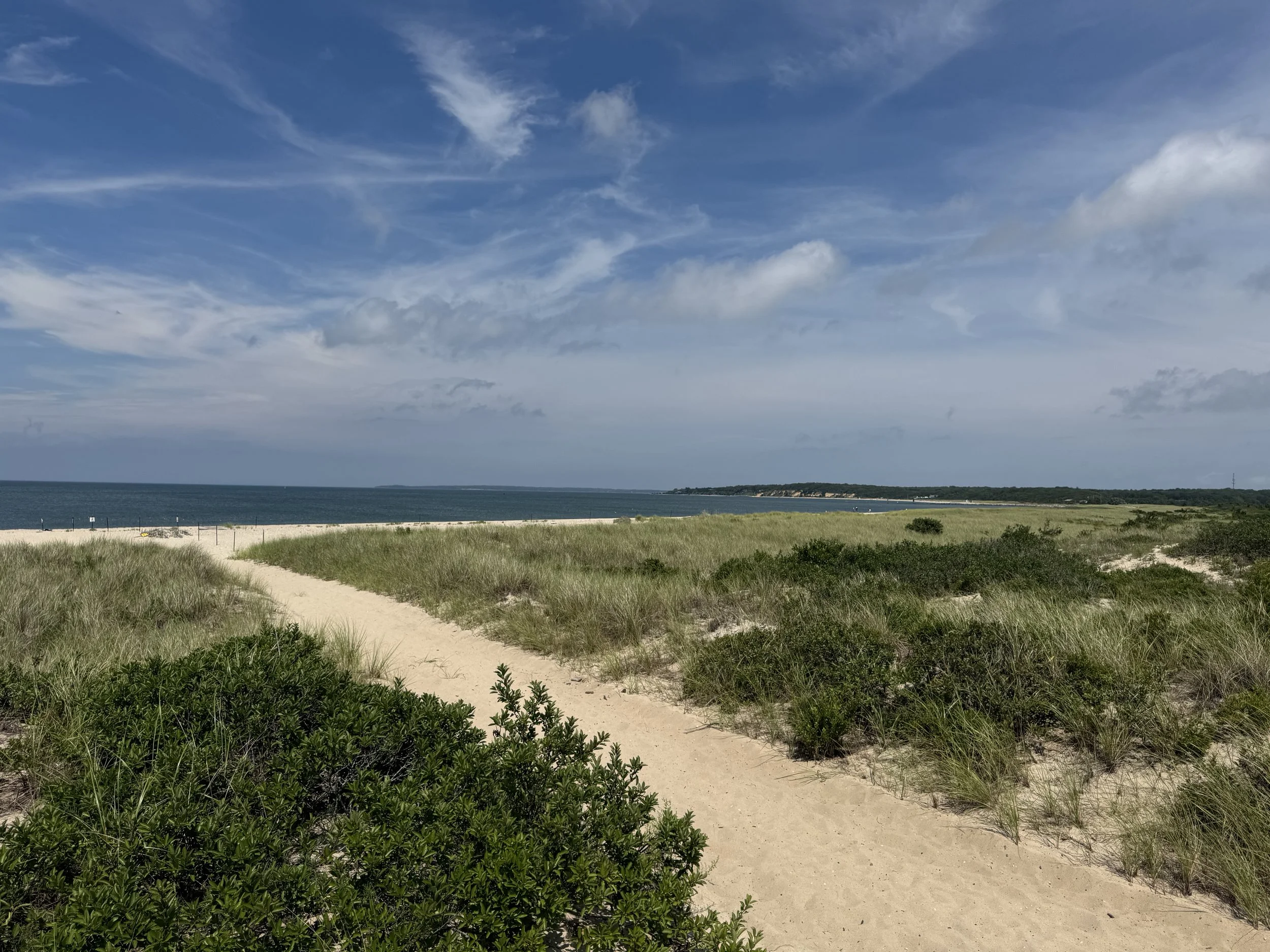
Nineteen-year-old Elizabeth Parsons, the unmarried daughter of Samuel Parsons, and another young woman very much wanted chests similar to the Osborne chest. It was a simple matter to order them from Mulliner's shop in Branford. Samuel Sherrill would deliver them. With the chests on his sloop, Samuel headed for Northwest – or perhaps tried to navigate the tricky channel into Three Mile Harbor. He ran aground along this northern shoreline of East Hampton, perhaps at low tide. At any rate, here was the boat, aground with the two Mulliner chests on board.
The young women in East Hampton had to go to the harbor to observe this threatening situation! Upon arriving at the shoreline, Elizabeth Parsons is reputed to have said - "That skipper is the handsomest man I have ever seen and I would marry him if I could!" This comment was made known to Samuel Sherrill and subsequently Samuel and Elizabeth were married, circa 1662. This romantic story has made Sammy's Beach famous, and the story is well known among Sherrill descendants. The beach where Samuel – or Sammy, as he was likely called – ran aground became forever associated with this idyllic meeting, and the name has endured for more than three centuries.
Most of this information came from well-documented research. One of the Mulliner chests, known as the Hedges Chest is now owned by the Society for Long Island Antiquities (now Preservation Long Island) and is on display at their gallery in Cold Spring Harbor. The Osborne carved chest is in the Home Sweet Home Museum. It has been included in such books as - Patricia Kane’s Furniture of the New Haven Colony, Dean Failey’s Long Island is My Nation, and Fairbanks and Trent’s New England Begins where the chest was exhibited at the Boston Museum of Fine Arts. The third Mulliner chest is in the Sherrill Family, having passed down from Samuel and Elizabeth Parsons Sherrill through twelve generations.
The name of this sandy spit of land has remained Sammy's Beach. It is so marked on nautical charts. The 1871 map of eastern Long Island notes the name.
Sources and End Notes:
Scott Smith-Bannister, Names and Naming Patterns in England 1538-1700 (Oxford University Press, 1997)
Patricia Kane, Furniture of the New Haven Colony, the Seventeenth-Century Style (New Haven Colony Historical Society, 1973); Dean Failey et al, Long Island is My Nation (The Society, 1976, reprint 1998); Fairbanks and Trent, New England Begins, 3 vols. (Museum of Fine Arts, 1982) where the chest was exhibited at the Boston Museum of Fine Arts, May 5-Aug. 22, 1982.
The Sherrill Mulliner chest was verified as a Mulliner chest to the author, 1992, by Robert F. Trent, Curator of Furniture for The Henry Francis du Pont Winterthur Museum
The author writes: The idea that it was called "Sammis" after a prominent Huntington Long Island family is a bit of pretension. None of the early histories of Long Island - Prime or Thompson- take any notice of the name. The possible only clue is to trace back Jonathan B. Mulford's title. [Nathaniel S. Prime, A History of Long Island (1845, reprint Book on Demand Ltd. 2013); Benjamin F. Thompson, History of Long Island, 3 Volumes (Robert H. Dodd, 1843; expanded reprint Services Corp. 1918).
Charles Hitchcock Sherrill, in his research The Sherrill Genealogy (Louis Effingham de Forest, 1932), dates the marriage of Samuel and Elizabeth as 1662, which Sherrill Foster verifies. They agree on these dates as well: Samuel Sherrill, born Cornwood, England 1633, died 1719 East Hampton. Elizabeth Parsons, born 1642, Lynn, Massachusetts Bay Colony, died 1722 East Hampton.