Researching the First East Hampton Sherrill
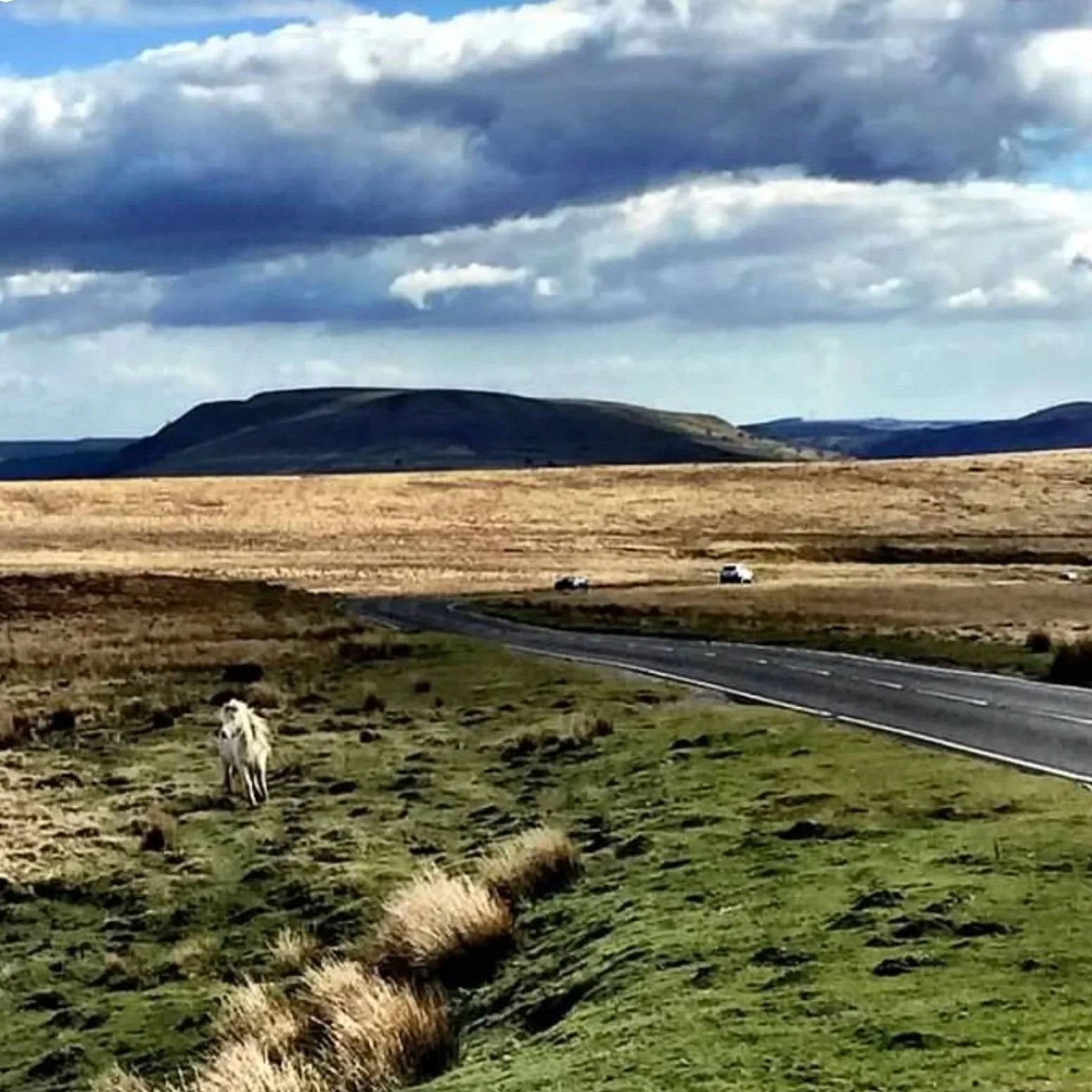
Introduction: The Bright Hills and Clear Springs of Devon
In my previous post, I shared the romantic legend of how Samuel Sherrill and Elizabeth Parsons met at Sammy's Beach. But that story raised as many questions as it answered. Who was this young sailor? Where did he come from? And how did my mother uncover the truth?
As I sorted through my mother's writings, I came across her essay "Researching the First East Hampton Sherrill c. 1640." I was astounded by the depth of her detective work. I knew she'd traveled to England on a genealogy tour and stayed after to take a bus to Cornwood, keen to research the birthplace of her "first immigrant," as she called him. What she discovered in the Devon parish records transformed our family legend into documented history.
I think you'll enjoy her story and be amazed by her dedication to the truth—and to a young orphaned fellow from a tiny village on the edge of Dartmoor who crossed an ocean to find his future.
When I would ask my mother about the origins of the name Sherrill, she would always say "we are a small family." That was certainly true in East Hampton, where Sherrills typically had few children and many younger sons moved away. There's even a Sherrill, New York, founded I'm sure by a son who ventured to what was then "the wild west" - central New York in the 1800s.
But I remained curious. Today, the name Sherrill has become rare in Great Britain outside of Devon. It was more common in the 16th and 17th centuries, with spelling variations during the Middle Ages: Sherrell, Sherwell. My interest is in those who retained our spelling - and, as our family found out, there are still Sherrills in Cornwood today.
The name derives from Old English meaning "bright hill" or "clear spring," connected to Devon and Cornwall, according to FamilySearch.
In colonial America, there are several known Sherrills. Most that I've found are those my mother called the "southern Sherrills" - they settled in Maryland and the Carolinas. The earliest I located is William Sherrill (the "Conestoga Fur Trader"), born around 1667 in Devon. That would make him the next generation after Samuel - possibly cousins? William settled first in Maryland, then moved south. He and his son Adam helped open the Susquehanna and Shenandoah Valleys for settlement, and Sherrill's Ford in North Carolina is named after his family (Sherrill Family, Official Internet Home of Catawba County, NC).
As my mother demonstrates, we may be a small New England family, but we love our history!
______________________________________________________________________
Researching the First East Hampton Sherrill c. 1640
By Sherrill Foster, East Hampton Town Historian 2003-2007
First appeared in Revealing the Past (East End Press, 2014). Updated by Mary Foster Morgan, 2026.
The origin of the first Sherrill has been obscure. Known is that his name was Samuel, he married Elizabeth Parsons in 1662, daughter of Samuel Parsons, a founding settler.
The Sherrill family has always lived in East Hampton, on the eastern end of Long Island, New York. The Town was settled in 1648-49 by a diverse group of New Englanders from the New Haven colony, from north of Boston and from the Connecticut River Valley, as well as several from the recently settled adjacent town of Southampton.
The family legend has it that Samuel Sherrill was "the sole survivor of a shipwreck". He came ashore with his oak chest 32" x 50" x 23", there to be observed by "Miss [Elizabeth] Parsons and a group of young ladies" and she said "He is the handsomest man I have ever seen and I would marry him if I could!" This account appears in Rattray’s East Hampton History (page 544.)
Reviewing this legend in light of late 20th century research, there are several clues to explore. Most important is the fact that there is no mention of this shipwreck in the East Hampton Town Records, although there are many other such notices.
If Samuel Sherrill survived a shipwreck, c. 1661 where did he stay while he recovered from this ordeal? The Town fathers would have had to pay someone for his care. When able to get about, where did he get a job? Authorities in the Connecticut colony (of which East Hampton was part at that time) would have had to have been notified; the other bodies accounted for, the remains of the ship assessed, and any possible cargo listed.
A sensible look at the situation suggests the possibility that Samuel Sherrill may have been a mariner sailing a small sloop and had merely run aground, very probably on the bay side, near Northwest Harbor. (Not on the ocean). Or, sought a sandy lee shore as a safe harbor in a storm for his cargo-laden sloop.
Here the early colonial oak chest becomes a clue.
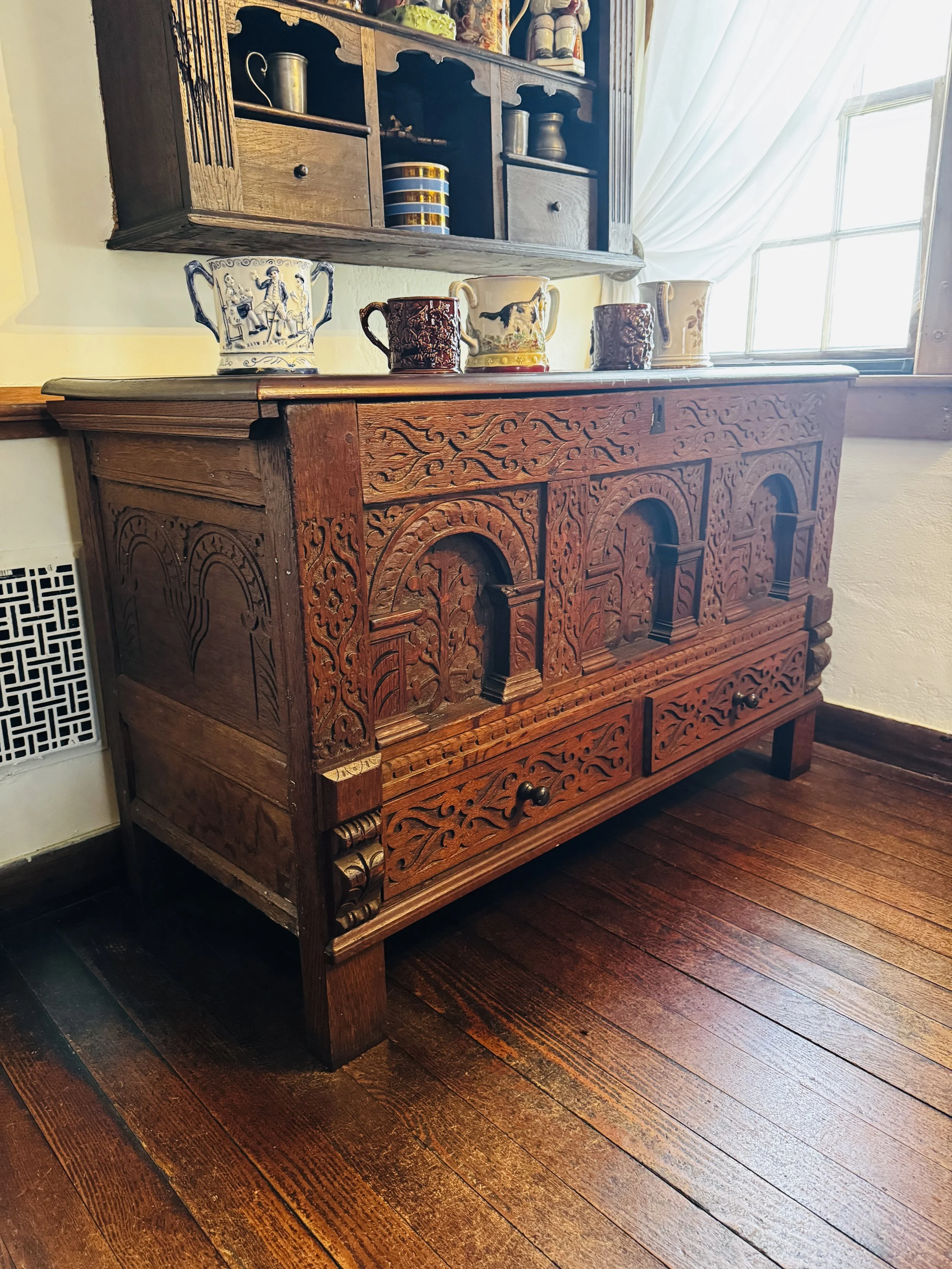
The Osborne chest at Home Sweet Home, East Hampton Historical Society
The facade panels of the Sherrill chest are identical to the side panels of the Home Sweet Home Osborne chest. Securely documented to Thomas and Elizabeth Osborne who came to New Haven in 1639 from Ashford, Kent, the chest was crafted by Thomas Mulliner, an outstanding New Haven joiner with superior carving abilities. (He apparently was not as good in business matters due to alcohol, as the colonial records of Swampscott and New Haven reveal.)
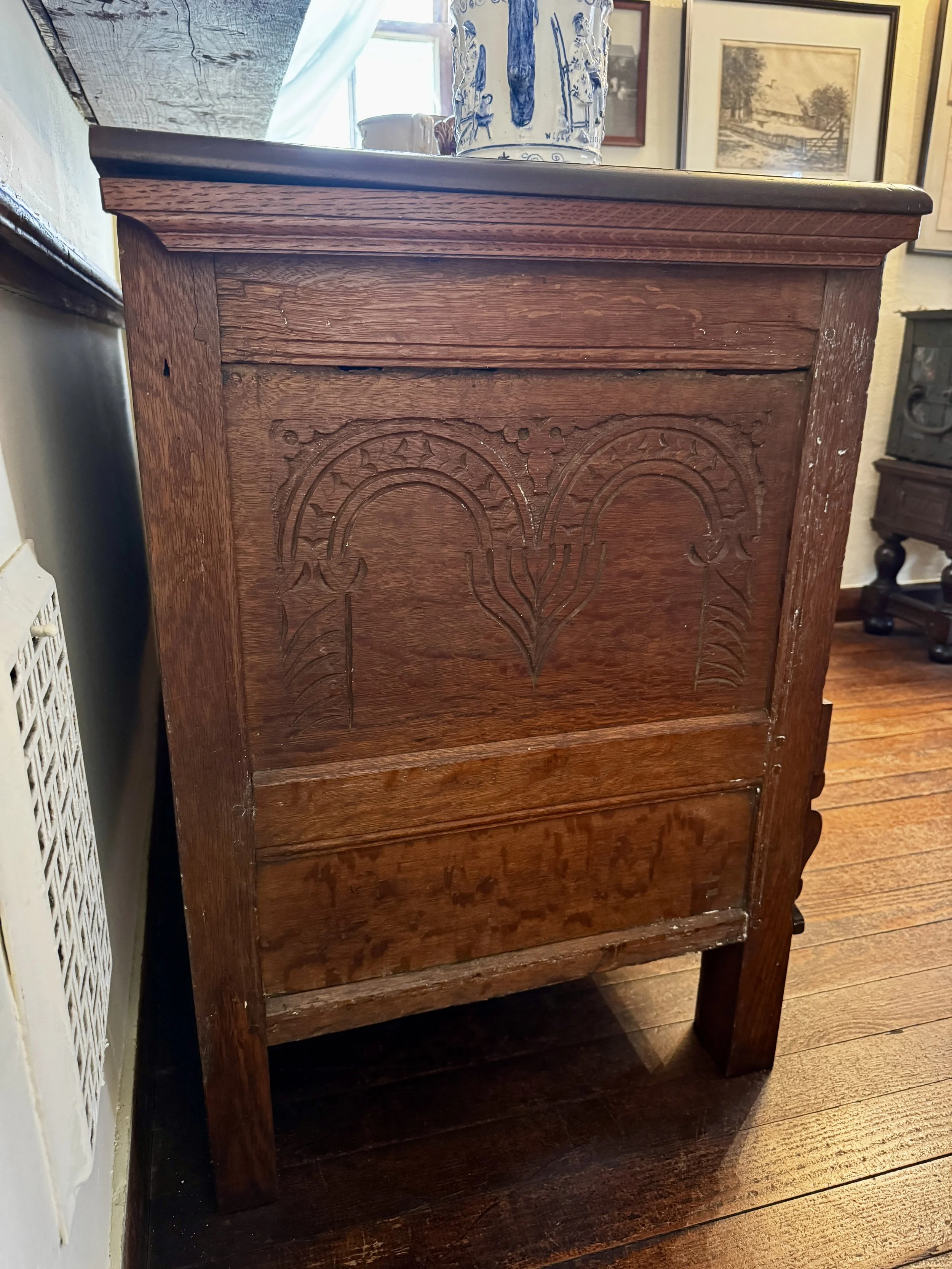
Side panel, Osborne chest, Home Sweet Home, East Hampton Historical Society
The Osbornes moved to East Hampton about 1650-51 with their family and their chest. The Hedges and Parsons were already here. William Hedges had arrived in 1649 and purchased a homelot the same year Samuel Parsons brought his family from New Haven.
The Osborne chest, a superb example of the joiners and carvers craft, undoubtedly elicited much interest among the residents of East Hampton. A similar Hedges chest (in the collections of Preservation Long Island) has carved panels but no romantic story. The Sherrill chest remains with the Sherrill family
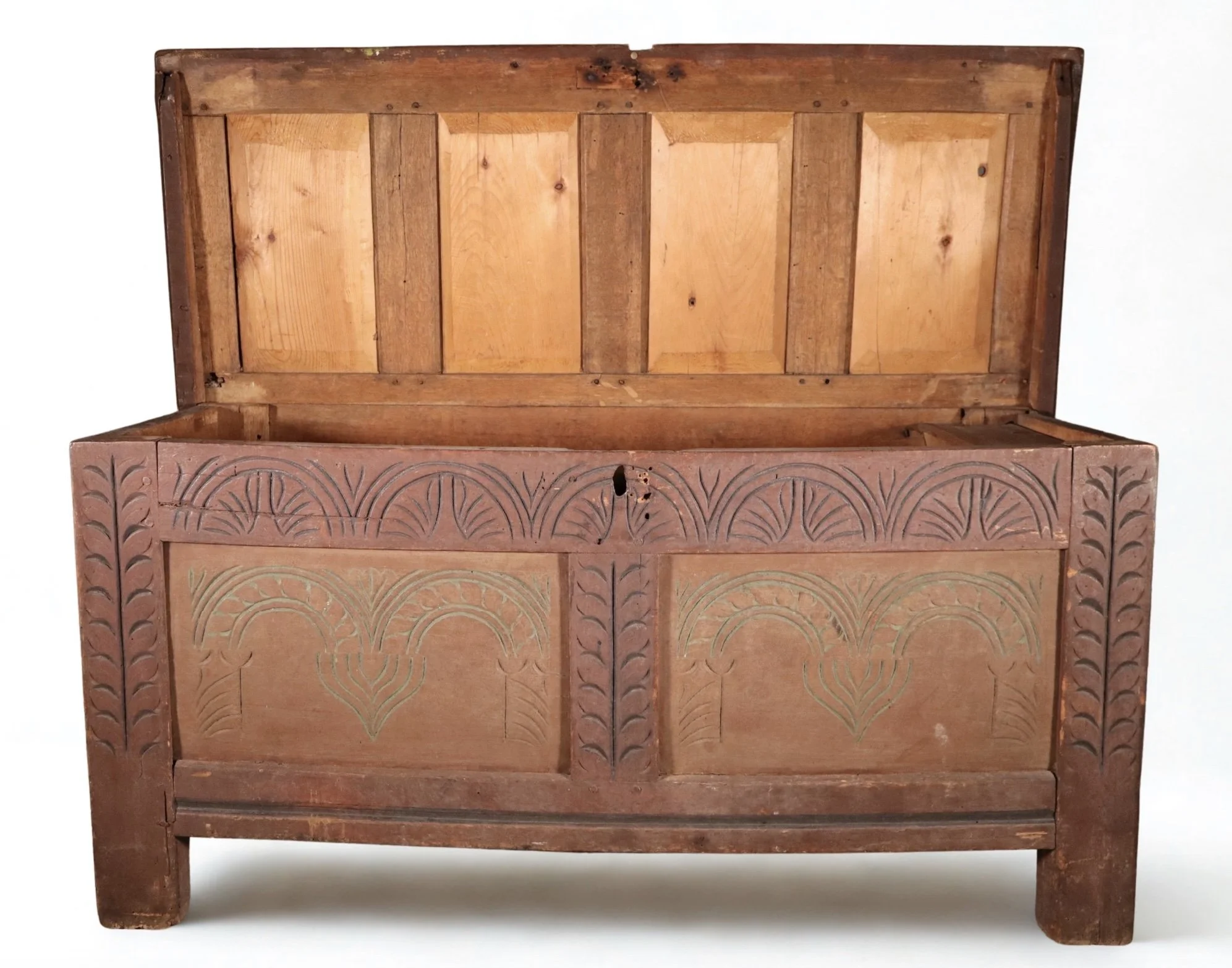
Hedges chest, Collection of Preservation Long Island
The local harbor in the 1660s was at Northwest (near the present Sag Harbor). This harbor is approached from the southwest corner of Gardiner's Bay, past Cedar Point with its present small lighthouse. To the west is Shelter Island, while on the east of the channel is the Northwest Woods, the woodlots of the residents of the Town of East Hampton. In the 1660s "Captain" Samuel Mulford had his docks here for his whale oil business, as did Samuel Schellinger, the route is still called Merchant's Path. This tidal waterway has many shoals - periodically small crafts run aground in this very area.
Thus Samuel Sherrill, skipper of a coastwise trading sloop in the employ of a major shipping firm such as that of the Christopher brothers of New London, was quite possibly delivering these two chests to their purchasers and ran aground at low tide before the entrance to Northwest Harbor. The young ladies had word that their chests were arriving, and went to the shore to check it out. Certainly a capable mariner working about his boat was a much more appealing sight than a half-drowned body lying on the beach! [Various Sherrill relatives find this a more plausible story].
Samuel Sherrill and Elizabeth Parsons were married (of course!).
That would have been in c. 1662. Did they start out their life together living with her widowed mother and older brother and his young family, in the house on their father’s (Samuel Parsons) original 1649 homelot? Records are mute here. However, as Samuel Sherrill is barely mentioned in the East Hampton Town Records, this may indicate that he was in fact a mariner, and not around to do much "fence viewing" etc.
Who was Samuel Sherrill and where did he come from?
In 1988 I was at the County Record Office for Devon at Plymouth researching my first ancestor, Samuel Sherrill, born c. 1630-1640.
For Cornwood (Reel 10, 1610-1811) we find baptised in Cornwood, son of William Sherrill, Samuel Sherrill 17 November 1633; buried in Cornwood, Elizabeth Sherrill 17 February 1633/4, William Sherrill 18 March 1633/4. Presumably these are his parents. Samuel Sherrill became an orphan at age 4 months. Surely there must be some record of his care, paid for by the local authorities, either church or civil. Another record states: William Sherrill buried 18 March 1633 (os) Elizabeth Sherrill buried 17 February 1633 (os) Samuel Sherrill christened 17 Nov 1633, son of William Sherrill.
In the records of Ermington, Parish of St. Peter and St. Paul (not included in the Sherrill Genealogy) we find (Ermington Reel 13, 1606-1812) William Sherrill and Elizabeth Cove were married 3 February 1611/12. Among the numerous children "of William Sherrill" there are two whose birth dates do not overlap: Sibilla Sherrill 15 November 1612 and Thomas Sherrill 24 November 1616, both children "of William Sherrill". Later in the Ermington records we find 'Siblye' Sherrill married 29 April 1633 to William Luxe. She was 20 years old.
As a bride of almost a year, would Sibilla/Siblye have been the one to care for her infant brother? or was he baptised as a youth? Why did the family move from Ermington six miles north to Cornwood, Samuel's place of baptism? Cornwood is a tiny place, sited on the edge of Dartmoor. Ermington, a larger, more inhabited place, is on the river Erme, a few miles from the coast.
Sibella Sherrill and William Luxe move from Ermington to a place north of Plymouth - Yelverton sticks in my mind. They have numerous children. One is a daughter Sibella Luxe, who has a child in Modbury, named William Luxe.
The name Sherrill is clearly written on the original Ermington marriage documents and Cornwood baptism documents. It is not to be confused with Sherwill, a family involved in shipping and the politics of Plymouth. It would appear that in the Sherrill Genealogy (Sherrill and deForest 1932) the name Sherrill and Sherwill or Sherwell has been conflated. This is the opinion of researchers at the Devon Record Office in Plymouth, England.
If East Hampton's Samuel Sherrill was born in Cornwood, Devon, near the English Channel in 1633, brought up by his older sister Sibella in Ermington, a fishing town, until he came of age, and had no property inheritance, did he then join the thousands of others emigrating to New England?
Endnotes and sources:
Historical Context: Why would a young Devon man in 1650 migrate to the colonies? A young man about 20 in 1650 in Cornwood or Ermington would have been living at the end years of the Great Migration of 1620-30. It was the time of upheaval for many: a civil war, the huge growth in the English Navy under the dictatorship of Puritan Oliver Cromwell, the Anglo-Dutch War, and the start of a new mass emigration of non-comforming Protestant English to the colonies.
Another family member visits Devon: In July 2001, Jonathan Sherrill Foster, the author’s son, visited a hamlet in Devon, where three stone house structures dating from the 16th century with thick thatched roofs exist on a road named "Sherrill." The owner verified that the houses were originally owned by Sherrills. Today the Sherrill Farm, 13 cottages converted from original 300-year-old barns and farmhouse set on 6 acres of countryside, can be visited.
Sources: Records on the International Genealogical Index (IGI); County Record Office for Devon at Plymouth: Ermington, Reel 13, 1606-1812; Cornwood, Reel 10, 1610-1811; Blackawton, Reel 4, 1597-1789. Charles Hitchcock Sherrill, The Sherrill Genealogy (Tuttle, Morehouse & Taylor, 1932). Jeannette Edwards Rattray, East Hampton History and Genealogies (Country Life Press, 1953).
The Osborne chest has been included in Patricia Kane, Furniture of the New Haven Colony, the Seventeenth-Century Style (New Haven Colony Historical Society, 1973); Dean Failey et al, Long Island is My Nation (The Society, 1976, reprint 1998); Fairbanks and Trent, New England Begins, 3 vols. (Museum of Fine Arts, 1982) where the chest was exhibited at the Boston Museum of Fine Arts, May 5-Aug. 22, 1982. The Sherrill chest was verified as a Mulliner chest to the author in 1992 by Robert F. Trent, Curator of Furniture for The Henry Francis du Pont Winterthur Museum.