Clues about the Early Sherrills - their Hope Chest and Pewter
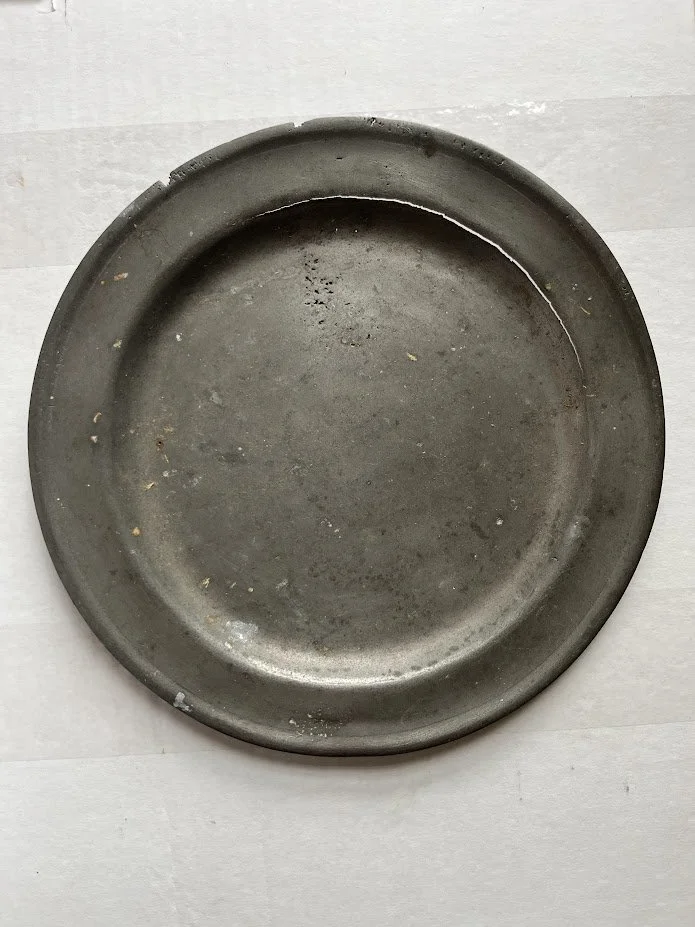
Sherrill Pewter, hammered pewter c. 1768. Photo: East Hampton Historical Society
Introduction: The Mystery of 128 Main Street
In my first post I explored how Sammy's Beach got its name and the romantic story of Samuel Sherrill and Elizabeth Parsons. In my second, I followed my mother's research trail to Cornwood, Devon, where Samuel was born in 1633.
But, to me, questions remained. What happened after Sammy and Elizabeth married in 1662? Where did they live? And how did the New Haven hope chest end up in my grandparents' home?
There's a lovely Federal-style house at 128 Main Street listed in the historic district as the Sherrill House or the Samuel Sherrill House. It seemed like the obvious answer.
Except it didn't square with my grandmother's story about "darling sister Puah" inheriting a house on Main Street. What house was that?
Following the clues through pewter plates, furniture, and family stories led to surprising discoveries about 128 Main Street—ones that involve both the Parsons and Sherrill families across five generations.
Writing this brought back memories of my visits to my grandparents, their Sherrill chest, and imagining Elizabeth Parsons. I tell the story of visiting a place that young Samuel knew. For me, history isn't just archival—it's felt, embodied, connected to land.
And darling sister Puah? That's a story for another post: A Tale of Two Sister Houses.
———————————————————————————————
Clues about the "Early Sherrills" – their Hope Chest and Pewter
By Mary Foster Morgan
Part I. Solving Mysteries
My grandparents' home at the Sherrill Farm on Fireplace Road held clues to the "early Sherrills."
Their large hope chest was their oldest piece of furniture—an oak and pine paneled chest carved with semi-circle lunettes that held pride of place in the parlor. It represented the story of how Samuel Sherrill, the "first Sherrill" in East Hampton, and Elizabeth Parsons came together. The chest, family said, came with skipper Sammy, transporting goods from New Haven across the Sound. From there, his life in East Hampton began. The hope chest, which we called the Sherrill chest, was the first clue.
The second clue was a great pewter bowl and several plates—what Grandma called "early Sherrill pewter." Pewter suggested a settled household, permanence, maybe even a touch of prosperity. Wherever Sammy and Elizabeth set up house, the pewter would have been in use.
But where was that? Elizabeth's early life offers another clue.
Elizabeth was American-born and came to Easthampton, as it was known then, with her parents and older brothers in 1649, when she was seven. She and her brother Robert were born in Lynn, Massachusetts Bay Colony. Their two older brothers, Samuel and John, had been born in Devon, England, as had her parents Samuel, and Hannah. The family emigrated from Devon to Lynn to New Haven and then to Easthampton, when Elizabeth's father brought his young family as part of a second wave of founding families, “the first Parsons,” arriving one year after nine enterprising men had founded a plantation near fresh water and grazing land at Montauk, a place "east of Southampton."
Town records indicate that Samuel Parsons was a large landowner. He and Hannah also ran the first school in their home. When Samuel died in 1660, Elizabeth was eighteen, living with her widowed mother on the Parsons homelot on Town Street, now Main Street. Two years later she married Sammy Sherrill. That same year her mother also passed away.
As was customary, large family plots were divided between sons. Elizabeth's older brothers, Samuel and John, split the homestead farm, while Robert, the youngest at twenty-one, received money to buy property. The brothers all married.
This is where Elizabeth’s story gets interesting. Perhaps after her marriage she and Sammy did live for a time with one of her brothers on Town Street. Although there is no record of this. What is recorded about these years, by Mrs. Rattray in Genealogies, is about brother Robert. On receiving his inheritance he bought property in town that included a house—I understand it was across the street from the Parsons homelot—with his eldest brother signing for him.
Tragedy struck a few years later, in 1665, when Robert died at age 27, leaving behind a five-year-old son named John. Records suggest young John's mother had died in childbirth. With no parents in the household, who raised the five-year-old?
Someone had to raise orphaned John. All signs point to Sammy and Elizabeth stepping in, living on or near the Robert Parsons property and raising young John. The pewter and hope chest suggest they had a permanent home somewhere during those years (1665-1681). They had no children of their own for about a decade. They bought land only when John came of age to inherit his own. And John, at 23, appears to have inherited a considerable amount.
Elizabeth and Sammy eventually had two children: a boy they named Recompence, followed by a daughter, Elizabeth, named for her mother. (Historians differ on Recompence’s birthdate: "before 1677" according to Rattray’s East Hampton Histories and Genealogies, while Charles Hitchcock Sherrill states in his 1932 The Sherrill Genealogy the date is 1677; both are unclear about Elizabeth’s birthdate.)
However, the timeline works. When nephew John turned twenty-one in 1681, and presumably took over his inheritance, Elizabeth and Sammy were then parents of young children – Recompence was at least seven, and his sister younger (if she was in fact born by then.) Right around that time, town records show Samuel Sherrill purchasing seven acres of his own and then another thirty on the Eastern Plains, land that may have been near Egypt Lane. In other words, as soon as their nephew claimed his inheritance, Samuel and Elizabeth established their own homestead.
What happened to nephew John? By age 23 he had established himself as a weaver, and had a "considerable estate" as noted on the town tax list. If you follow his life, he relocated to Cape May County, New Jersey, where he established a cattle plantation and raised a family.
In Easthampton, Sammy and Elizabeth's story continues. Their two children, Recompence and Elizabeth, stayed rooted nearby. Daughter Elizabeth married Hezekiah Miller of Wainscott. Son Recompence married and raised a large family in Easthampton. I've been reading accounts of his story researched by Charles H. Sherrill — a fascinating glimpse into his character as a "leading citizen" and member of the town militia.
Recompence’s eldest son, another Recompence, carried the line forward, now the third-generation Sherrill in Easthampton. My grandmother knew something about him and his wife, as he married a Parsons — Puah Parsons, the "darling sister Puah" from my grandmother's stories.
Puah, a great-granddaughter of Samuel Parsons of the “first Parsons,” had grown up in her grandfather’s house on Town Street, now 128 Main Street. And when she married, husband Recompence joined her there.
The story now turns full-circle. The Parsons house on Town Street, Elizabeth and her brother’s childhood home, became the home of another family: the Sherrills. It passed to Puah and her husband Recompence Sherrill, who raised their three sons and two daughters there.
Today, this same house appears on historical walking tours as the Sherrill House. It was inherited through the Sherrill sons, who added the elegant Federal doorway. It is sometimes called the Samuel Sherrill house — but the name is misleading. Samuel Sherrill never lived there nor owned the property. It was where Sammy’s wife Elizabeth had grown up, and most likely where they married.
The Sherrill pewter and hope chest owned by Sammy and Elizabeth may have passed down through first son to grandson Recompence, ending up full circle too. —- practical items and treasured heirlooms used by Recompence and Puah Parsons Sherrill at 128 Main Street, with their five children: Recompence, Abraham, Sarah, Stephen and Puah.
Curiously, then, how did the chest and pewter find their way to my grandparents' home, a home inherited from Abraham, a second son?
Perhaps Abraham’s widowed mother Puah broke with tradition, making them a wedding gift on his marriage in 1800 to Anna Huntting. And then lovingly passed down.
The hope chest, the pewter, the deeds, the town records—each is a clue. Alone they are fragments, but together they sketch the life of a young couple who began their marriage not in their own home, but in service to family, in the heart of Easthampton. These family heirlooms, carefully preserved, offer tangible proof that Sammy and Elizabeth planted roots in Easthampton that would carry forward through the generations to my Sherrill grandparents.
The clues tell us where that first couple likely lived, but clues can't capture everything. There's another way to know Elizabeth's story, one that has nothing to do with property records and everything to do with a teenager like me, standing in my grandmother's Victorian parlor on a summer afternoon, light filtering through white curtains, looking at her New Haven chest and wondering: what was that young bride like?
Part II. She was just 18
Genealogy, I have found, can tell us only so much. To understand Elizabeth, I had to imagine her world—and my own teenage self was the key.
Elizabeth was just 18 when her father passed away. Twenty when she married. I remember being her age, and I was, of course, intrigued with her story. Right before us was the large wooden chest, her hope chest, carved with vines and arches, looking so early English, so medieval. Grandma’s parlor room was rather “off limits” – you weren’t allowed to actually sit on the red velvet Victorian sofa or the matching pincushion chairs. But when the late afternoon light filtered through the white curtains – they were a kind of gauze, like a bridal veil – the room seemed filled with romantic mystery.

Sherrill chest, detail, private collection
That providential day in Elizabeth’s life, at 19, was she walking the beach with friends? Or watching for a delivery by a coastal sloop from New Haven?
Grandma had the answer—the romantic family story about the bachelor sailor that appeared in Rattray's East Hampton Histories. By the time I was eighteen, my mother had already debunked the “shipwreck” version through careful research (as I wrote about in my earlier posts). But standing in that parlor, I still imagined Elizabeth then….
We were reading Thomas Hardy’s The Return of the Native in school, and I remember thinking of Elizabeth Parsons as a kindred spirit to Eustacia Vye – that restless young woman who loved to walk the wild heath. Eustacia loved the moor, Elizabeth the beach. To me Elizabeth was so distinctly American – being born here in the colonies, in Lynn, just north of Boston. She was only seven when she arrived with her parents and older brothers to the new “plantation” of Easthampton. It was 1649. What was her childhood like?
While Elizabeth was so American, Eustacia Vye was so English, a heroine from a novel set in a rugged rural landscape. What had captivated me about Eustacia’s story was her endless wanderings across Dartmoor - that ancient stretch of Devonshire heathland where wild ponies roam.
Years later, I finally stood on Dartmoor myself. I was following the path my mother had traced when she traveled to England with a genealogy group, and headed southwest to Cornwood, notebook in hand, determined to see the parish records with her own eyes. She wanted to authenticate Samuel's birthdate and place, which her cousin Charles Hitchcock Sherrill had written about in his Genealogy. There it was, Samuel Sherrill, November 17, 1633, son of William Sherrill, baptized in Cornwood, Devon. Visiting the little village I was able to find that Sherrills still live there. And, to my surprise, Cornwood is just 8 miles from the moorland Dartmoor. Samuel himself must have walked that same open country.
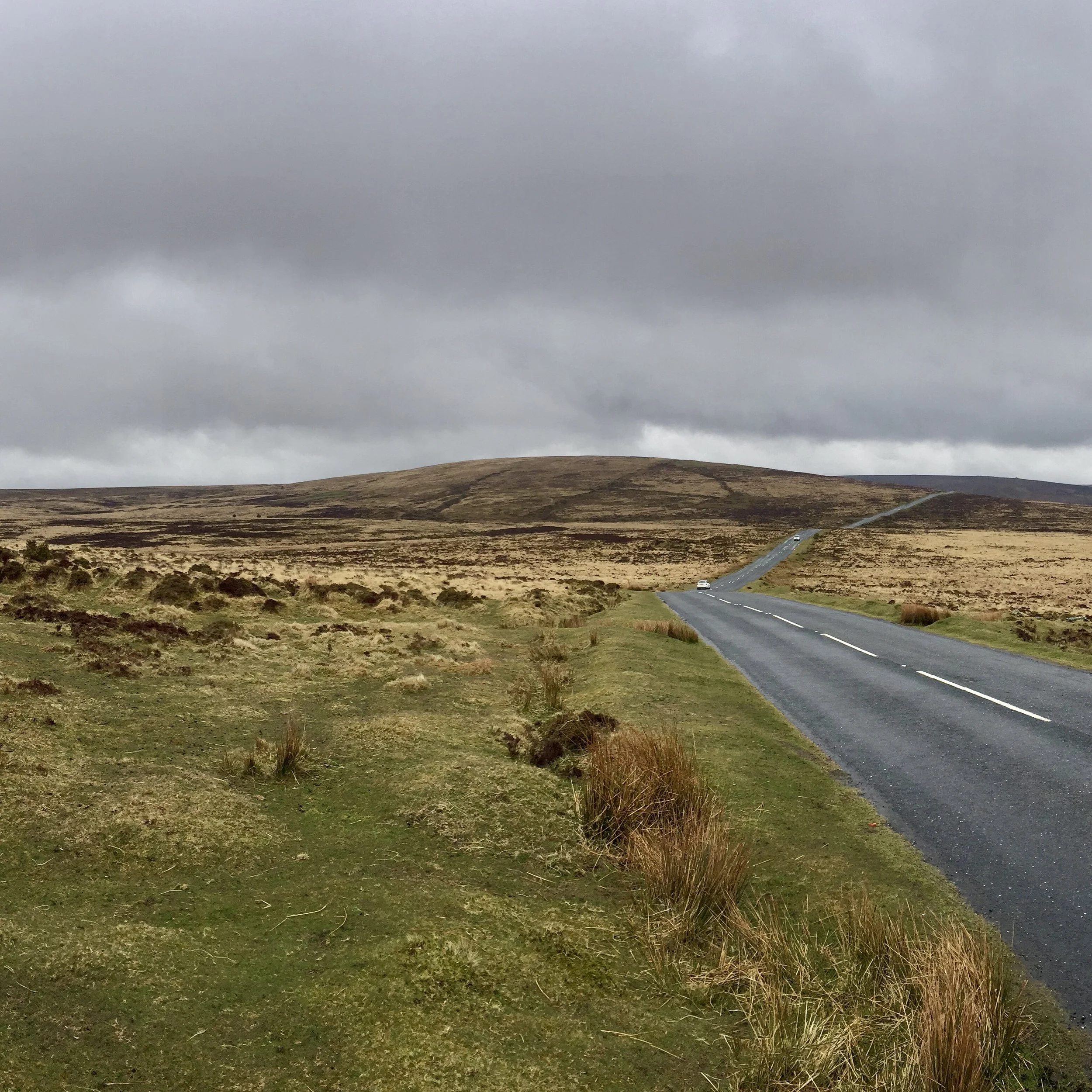
I was awestruck as Tom and I drove into Dartmoor National Park. Standing there I thought of young Samuel Sherrill, he knew this place. I felt an uncanny connection to the landscape, a recognition that resonated and ran deep – it felt so familiar. The ancient moorland stretched before me in all its craggy splendor and untamed beauty, breathtakingly vast.
Notes and Sources:
Material Culture
The Sherrill Mulliner chest was verified as a Mulliner chest to the author, 1992, by Robert F. Trent, Curator of Furniture for The Henry Francis du Pont
Early Sherrill Pewter, a large bowl, large plate and smaller plates, one hammered pewter plate inscribed “1768” on bottom of rim, now in the collection of the East Hampton Historical Society, gift of Mary Foster Morgan.
The Sherrill Mulliner chest was verified as a Mulliner chest to the author, 1992, by Robert F. Trent, Curator of Furniture for The Henry Francis du Pont Winterthur Museum. It is one of three Mulliner chests with the same provenance. The Hedges Chest is now owned by Preservation Long Island) and is on display at their gallery in Cold Spring Harbor. The Osborne carved chest is in the Home Sweet Home Museum. The Sherrill Mulliner chest remains in the family, having passed down from Samuel and Elizabeth Parsons Sherrill through twelve generations.
Family Records
The Parsons had made the passage to the colonies with Samuel's older brother Robert, c. 1635, who stayed in New Haven and bought land there.
Parsons birth and death dates: Samuel (1604-1660) and Hannah (1600-1662). Children: Samuel (1630-1714), John (1635-1685), Robert (1638-1665), Elizabeth Parsons (1642-1722). Robert’s son John (1660-1695).
Several genealogical sources list 1660 as the year of Samuel Parsons's death. Rattray says "before 1660." However, 1660 is most commonly cited. Jeannette Edwards Rattray printed the family account in East Hampton Histories and Genealogies (Country Life Press, 1953),
Sherrill birth and death dates: Elizabeth and Sammy Sherrill’s children: Recompence (1664-1743), Elizabeth (birth date uncertain; died 1755). Recompence’s son: Recompence (1706-1786).
Published Sources
Charles Hitchcock Sherrill, The Sherrill Genealogy (Louis Effingham de Forest, 1932)
Jeanette Edwards Rattray, East Hampton History and Genealogies (Country Life Press, 1953)
According to Nancy Hayden Woodward, East Hampton: A Town and its People (Fireplace Press, 1995), Easthampton early founders in 1648 were: Joshua Barnes, Robert Bond, John Hand, Sr., Daniel Howe, John Mulford, Robert Rose, John Stretton, Sr., Thomas Talmage Jr., and Thomas Thompson. In 1649 others followed and purchased homelots, including Baker, Barnes, Conklin, Dayton, Fithian, Lion Gardiner, Hand, Hedges, Osborn, Parsons.