Tale of Two "Sister" Houses – Sherrill or Parsons?
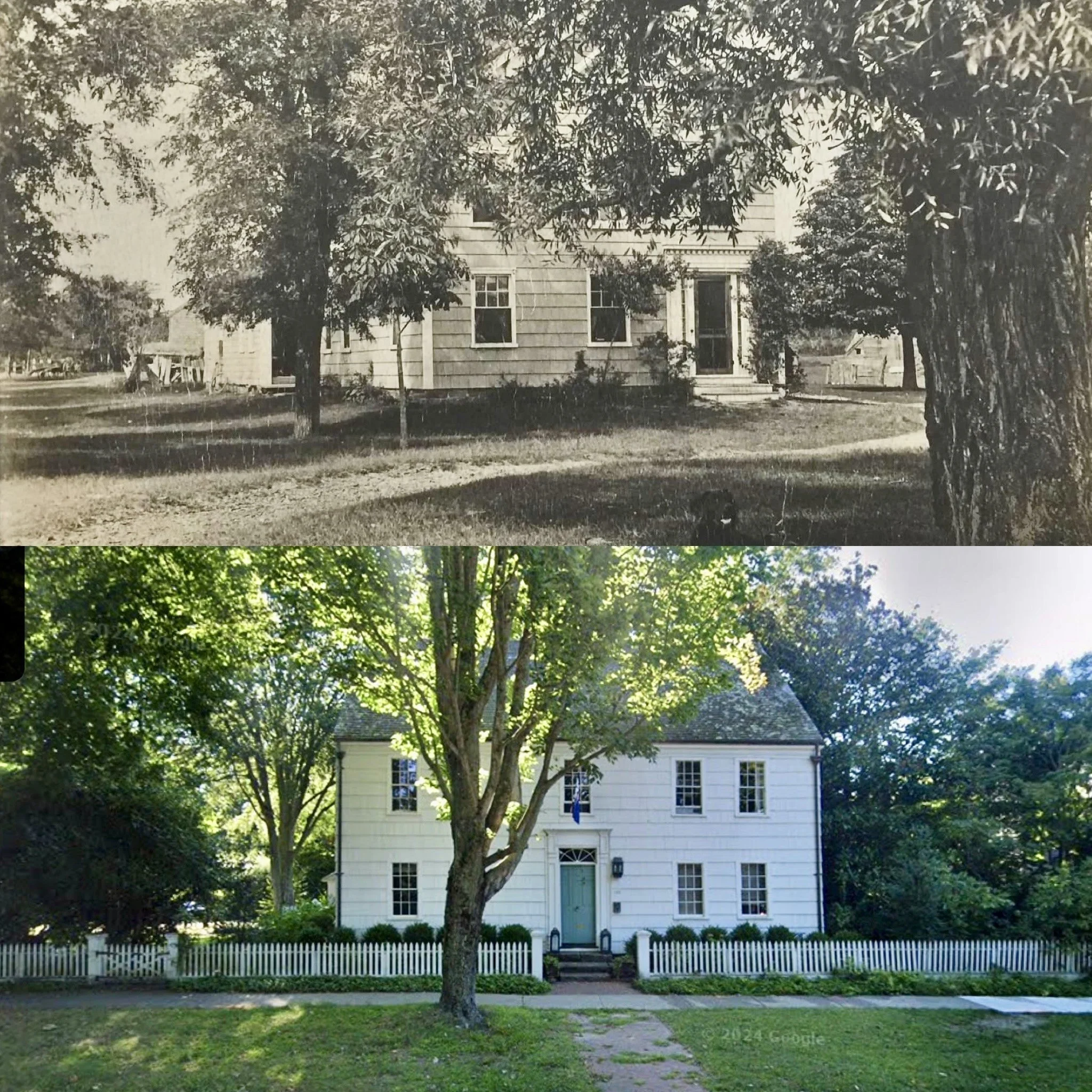
Above: Stephen Sherrill House, Fire Place Road, photo c. 1800, Below: Sherrill House, Main Street, photo c. 2025
Introduction: Story of the Story
From childhood, something puzzled me about the Sherrill Federal-style house at 128 Main Street in East Hampton. It's attributed to Samuel Sherrill, as if Samuel and Elizabeth Sherrill lived there. But it never seemed right.
Turns out it wasn't. Samuel Sherrill never lived in or owned that house.
Following the trail of my grandmother's stories about "darling sister Puah" and her Parsons family led me on a path of discovery—tracing five generations of inheritance, property transfers and family connections. And along the way, I finally understood what my grandmother meant when she talked about those two Sherrill sister-houses.
But there were things she didn't tell us. My research uncovered intriguing insights about East Hampton family values and customs that still resonate today.
When I mentioned my discovery to Irwin Levy on an East Hampton Trails Preservation Society walking tour, I had no idea he was both president of the trails society and founder, with Esperanza Leon, of Our Hamptons Podcast. Irwin loved the story and invited me to share it on the podcast.
So here's A Tale of Two Houses as I told it there (see Notes below for link) —and as I'm writing it now for you.
And many thanks to Irwin and Esperanza for encouraging me to tell this tale!
——————————————————————————————————————————————
Tale of Two "Sister" Houses – Sherrill or Parsons?
by Mary Foster Morgan
Visiting the Sherrill Farm
Summer heaven was my Sherrill grandparents' farm at 4 Fireplace Road in East Hampton where North Main Street branches toward The Springs. I remember those vast farm fields that stretched to the sea, the glittering surf and white white sand of the ocean, and always that soft salty air.
In the 1950s, my grandfather was in his final years of running Sherrill's Dairy. He still kept a dozen cows grazing in the pasture behind the house. From the backyard fence, you could watch their habits, settling into the cool under Hackberry trees or trailing in a line to a new pasture.
At dawn, I'd hear Grandpa preparing for his milk route. Once, he let us tag along, bundling us into his pick-up truck, everything dark and quiet – we were told to whisper – as he maneuvered pebble drives to deliver milk to the summer people, careful not to wake them.
Some summers Grandma would host the annual Sherrill Picnic, and her backyard would swarm with aunts, uncles and cousins of all ages, all sharing the same Sherrill name. Picnic tables were chock-a-block with family dishes; my favorite was always Grandma's clam pie.
Grandma's Stories
I also loved Grandma's stories. I could tell she felt she lived in a house of special significance. The Sherrill House had been in the family for five generations—six if you counted my mother. Above the parlor mantle hung a portrait of Nathaniel Sherrill, the great-grandfather whose father had renovated the house. "In 1858, for his wedding," Grandma would say, pointing to an image of a fellow with a neatly trimmed beard and a slight smile, looking a bit like Grandpa.
She would tell us how Nathaniel’s grandfather, Abraham, a Revolutionary War veteran, bought the property from the Conklings in 1792. Grandma would point to the framed deed hung on the wall, listing the purchase of 19 acres, a house, a barn and a shop. In 1800, Lt. Abraham resigned his commission to marry his childhood sweetheart —Grandma’s words — Anna Huntting and together they moved to the farm to raise three boys.
The story was always that Anna and Abraham’s eldest, Stephen, who inherited the house, had it enlarged and remodeled in preparation for his son Nat’s marriage. He hired the same Sag Harbor builders who had constructed the Old Whalers Church to give the home the Greek Revival look that he liked, including a flat-columned entryway and temple-like fireplace, all painted white.
Years later, my mother, Sherrill Foster, an architectural historian and later town historian for East Hampton, recognized its significance as an early example of Greek Revival architecture and applied for its inclusion in the National Register of Historic Places. It is now listed as the 1858 Stephen Sherrill House.
Two Sister Houses
Grandma called them “sister” houses—the farm at 4 Fireplace Road, and the Federal-style house at 128 Main Street near the Presbyterian Church where Aunt Addie and Aunt Flo lived. I guess because they were both Sherrill houses, both filled with family history.
I remember visiting Aunt Addie and Aunt Flo—Adeline Sherrill and her younger sister Mrs. Theodore H. Rowland, both in their 70s. Aunt Addie was especially memorable: small and frail, with a warm smile and sparkling blue eyes, taking my hand – she was not much taller than I was!
The two sisters lived in a house which had belonged to their father Hiram, an elected town official and man-about-town fellow, a house that belonged to his father Hiram, and before him David, who inherited it from his father Recompence. The elegant Federal-style doorway that we see today is a renovation by David Sherrill, c. 1800, and is included in walking tours of the East Hampton Historic District.
But first, to understand how these houses became sisters, you need to know about Grandma's Parsons family.
Grandma's Parsons Family
Grandma's family, the Parsons, she would tell us, were among East Hampton's founding families. She had helped her good friend, Jeannette Edwards Rattray "sort out all the Parsons" when compiling the East Hampton Histories and Genealogies.
Grandma liked to say that her fourth great-grandfather, John Parsons, and his older brother Seth, had left town in their teens "to build at Fire Place" because "East Hampton was getting too crowded for them." Too crowded seemed a cryptic comment, what did she mean? But you didn't question Grandma!
There was something else that Grandma told us that seemed particularly mysterious.
She called herself a Fire Place Parsons because her ancestors – John and Seth – started farms at Fire Place. Seth, the eldest, inherited the family in-town homestead when his father died, and significantly, he left it to "his darling sister Puah."
That phrase captivated me. How did Grandma know? She had Seth's will! And she would wave her hand as if holding the will and say she donated it to the East Hampton Library's Long Island Collection. That is all she would say about it.
My Own Discoveries
My grandmother's story about "darling sister Puah" has stayed with me. I wanted to know more about her, and why Grandma called the two Sherrill houses sisters. Were Grandma's stories were true or just family lore?
Grandma knew the Sherrill House on Main Street was built on early Parsons property—Mrs. Rattray had confirmed this in her Genealogies. The first Parsons — Samuel and Hannah/Johanna — arrived in Easthampton, as it was called in 1649, with their young family of four children. They purchased a homelot to farm – property that was passed down through four generations of firstborn sons: Samuel to Samuel Jr., who named his firstborn Seth, then it passed to Seth Jr.
Seth Jr. was the very one my Grandmother would tell us about. Remember Seth's will? And the story that when Seth passed away at Fire Place, he left the Parsons in-town home to his "darling sister Puah."
Yes, Puah. (I always loved her unusual name. It comes from the Hebrew meaning "shining" or "radiant" and not commonly used in colonial America.)
Why not look for that will that my grandmother said she gave to the library?
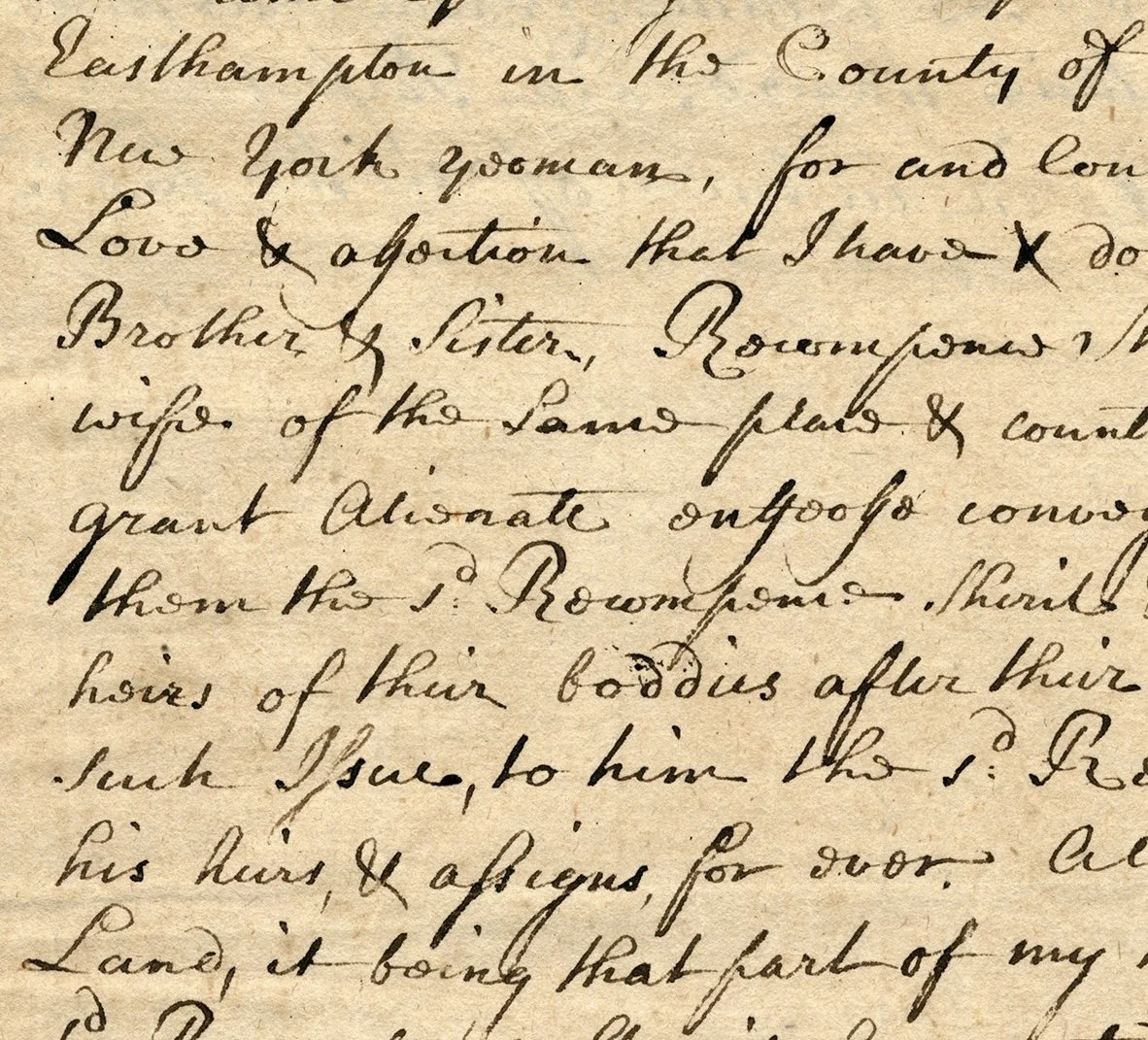
Deed of Gift, Dated 1741
A Christmas Gift
I now think I've found something better – a gift.
In the archives is a deed dated Christmas Day, December 25, 1741. It documents a gift of the Parsons in-town property from Seth to his sister Puah.
He was 39, and she was 25, newly married with an infant son. The gift is to both Puah and her new husband, a legal requirement in the colonies – as in the United Kingdom, single women could own property, while married women owned property together with their husbands.
Seth wrote in his deed: "for a consideration of the great Love and affection that I have & do bear unto my loving Brother and Sister."
The gift is loving, generous, and unusual.
Not many women in Easthampton at that time owned property.
I can only imagine what older brother Seth was thinking. His sister Puah had stayed home taking care of their widowed mother, Sarah – who lived long enough to see her youngest marry and give birth to a grandson.
I'm still searching for where Grandma found the exact phrase "darling sister Puah." The deed is dated 1741, but Seth didn't die until eleven years later. Was there a note with the deed? A letter? Or perhaps it was Grandma's own rendition of Seth's words.
Puah would go on to raise five children together with the fellow she married — Recompence Sherrill.
It was their eldest son, another Recompence, who inherited the now-named Sherrill house on Main Street – a home I imagine the whole family thought of as the Parsons family homestead, and maybe even their mother's house.
Their second son, Abraham, was to serve in the Revolution and buy the Conkling farm - his 1792 property deed in my grandparent's parlor.
Living Link between Houses
And now my story comes full circle. What a welcome surprise to realize that Abraham, my 4th great-grandfather, was the living link between both houses.
He was the Sherrill who connected them – he grew up in one, his mother Puah's house at 128 Main Street, and then raised his own three sons in the other, the farm he purchased at 4 Fireplace Road. Is this why Grandma thought of them as sister houses? She never said.
I suspect Grandma may have been thinking of the Sherrill name. It's fun to imagine she secretly thought of them related as in both houses, although separated by five generations, there was a marriage of a Parsons and a Sherrill.
But I think there was something deeper she sensed but couldn't put into words. Too sensible to say it aloud, perhaps. Though I the pride in her voice telling us she was the first woman in her family to vote in 1920.
Another Sisterhood
To me, the brotherly gift gives another meaning to sister houses that goes deeper than the Sherrill name or Abraham's journey between them.
It was a sisterhood of ownership—a pattern that repeated across generations.
In 1741, Seth broke with tradition to give the house to his sister Puah, who held title to 128 Main Street when it was still the Parsons ancestral home. More than a century later, the pattern echoed: Adeline Sherrill—Aunt Addie—inherited that same property from her father Hiram.
Two women, separated by six generations, each owning the same house in their own right. That's the sisterhood I see— a legacy of women as property holders, their families defying the inheritance customs of their time.
The story of Puah is one I cherish – a brother's loving gift to his sister. Born Puah Parsons, she lived all her 81 years (1716-1798) in the house on her great-grandfather Samuel Parsons' homelot, raised her children there, and then passed it on to her eldest.
So for me, 128 Main will always be the Puah Parsons Sherrill House.
Notes and Sources:
A Tale of Two “Sister” Houses – Sherrill or Parsons, first appeared as a podcast on Our Hamptons, June 30, 2025. https://ourhamptonspodcast.com/ Our Hamptons: A Tale of Two Houses
You can find a visual walking tour of East Hampton Main Street’s historic district on the Art & Architecture Quarterly website.
Jeannette Edwards Rattray, East Hampton History and Genealogies (Country Life Press, 1953)