Long Island after the Battle: What Happened Here?
#1 in East Hampton and the Revolution — A Series
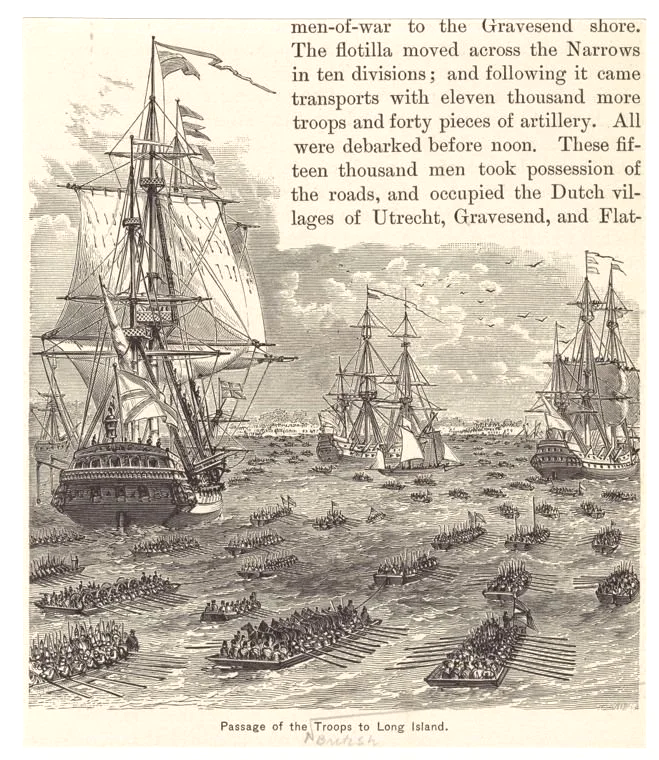
The Miriam and Ira D. Wallach Division of Art, Prints and Photographs: Picture Collection, The New York Public Library. "Passage of the troops to Long Island" The New York Public Library Digital Collections. 1879. https://digitalcollections.nypl.org/items/5eb7c310-c530-012f-fe2f-58d385a7bc34
Introduction: Our Revolution also Fractured Us
My mother was drawn to the details of lived history —the recruitment incentive of clothing that changed three times in one year, the names of nine Long Island physicians who left their communities to serve in military hospitals, the specific Connecticut towns where 4,000 refugees would soon land. She had the insight to look at what's been overlooked – overshadowed by the grand narrative of military victories.
She counted occupations in militia rosters—39 weavers, 20 cordwainers—because those numbers explained why an army desperate for clothing couldn't get it: they'd enlisted the men who made it.
She understood how strategically important Long Island was—its resources, its harbors, its location. But she also understood our vulnerability. My mother, a sailor, would have immediately grasped the truth of one historian's observation: "the eastern tip of Long Island posed few obstacles to a sailing army.”
This essay, found among her unpublished papers, dated 1998, reveals her characteristic approach: pulling facts from primary sources to understand not just what happened during the Revolutionary War, but how it felt, the cost in sacrifice, and how ordinary systems collapsed under extraordinary pressure.
The Battle of Long Island lasted only hours on August 27, 1776, but its consequences shaped the region for seven years of British occupation, from late August 1776 until the end of the Revolutionary War in 1783, and beyond.
My mother was particularly interested in what happened immediately after the battle—how a functioning colonial society transformed overnight into a crisis requiring emergency evacuation. She was drawn to the facts of how New York State government operated in exile from Connecticut, and how the Continental Army's desperate need for supplies created an innovative financing scheme that tied war bonds to confiscated property.
For her this wasn't abstract history. Families she had grown up with, and her own – Hedges, Conkling, Parsons, Sherrill —had ancestors who lived through this displacement. She documents how this was a crisis of people fleeing their homes, communities losing their doctors, neighbors' property being confiscated. She doesn’t romanticize history as simple — she tells the truth, honoring enslaved people by making them visible. This is the war as experienced by Long Islanders: not a series of distant battles, but immediate occupation and losses estimated at over $500,000 that were never fully compensated.
The subscription scheme she describes—citizens lending $500 (an enormous sum) to supply the army, with repayment in either interest or credit toward purchasing forfeited Loyalist lands—fascinated her because it shows how revolutionary economics actually worked on the ground. Who could afford that subscription? What did it mean that repayment came through redistribution of your neighbors' confiscated property?
Her essay may read as a collection of details, but that's exactly her method: accumulate the specific evidence—the 1,109 pairs of buckskin breeches stored in Philadelphia, the cold rain on August 28th—until you can see the whole system straining and breaking.
This is just honest. Yes, we won independence, and also, we tore ourselves apart in the process.
Long Island after the Battle: What Happened Here?
By Sherrill Foster, East Hampton Town Historian, 2003-2007
Compiled from essays appearing in Around the Green, East Hampton Independent, 1993-2007, edited by Mary Foster Morgan 2026
Eastern Long Island was considered part of New England from its earliest settlement in 1606, included in James I's description of the new world as "Northern Virginia." The Dutch arrived after 1609 when Henry Hudson sailed up the Hudson River as far as present-day Albany. By the time of the Revolution, these overlapping colonial claims had sorted themselves out, but Long Island's geographic position remained strategically critical.
New York State was second only to Massachusetts in the number of men who served in the Revolutionary War: 43,645, or 51,972 if land bounty rights are included. But by 1776, the government of New York State had already been forced into exile, operating from Kingston on the west side of the Hudson River. Meanwhile, the royal Governor of the Province of New York, William Tryon, conducted business aboard the warship Duchess of Gordon in New York Bay, where he had been since October 13, 1775.
Why Long Island Mattered
New York City, the colonies' second-largest city, and Long Island with its many harbors, extensive grazing lands, forests, and market gardens, became a strategic prize for both General George Washington and the armies of King George III.
Long Island's great grazing lands on Hempstead Plain and Montauk contained 100,000 head of cattle and a similar number of sheep—resources that could feed either army for years. The island's harbors offered safe anchorage for naval fleets. Its forests provided timber for ship repair and construction. Its market gardens could provision thousands of troops.
By summer 1776, Montauk had already been harassed by British landing parties seeking to seize livestock. A small East Hampton detachment famously marched around a hill, changing coats at the bottom to fool the British into thinking the place was defended by a greater force. It was a clever ruse, but it revealed the underlying reality: Long Island's militia was badly outnumbered and could only delay, not prevent, British occupation.
The Battle, August 27, 1776
The fateful Battle of Long Island was fought on August 27, 1776, along a high ridge running five miles from Brooklyn to Jamaica, known as the Heights of Guan (today's Prospect Park, Highland Park, and Forest Park). Four passages cut through these thicket-choked hills: near Gowanus Bay, Flatbush Pass, Bedford Pass, and Jamaica Pass.
On the night of August 26 only 550 patriots defended the ridge at each pass—a total of roughly 2,200 men spread across five miles. Facing them were units of 5,000 British troops advancing toward each position. The numerical disparity was staggering.
The British had learned from Bunker Hill that they needed overwhelming force. They had hired Hessian soldiers to supplement the regular army, and all were brought into New York Bay where Governor Tryon maintained his shipboard headquarters. The combined British and Hessian force totaled approximately 20,000 men—nearly ten times the American defenders.
Washington's Logic – and Miscalculation
General Washington, with complete intelligence about the size of these British units, waited in Manhattan to defend the city. He expected General Sir William Howe's army and Lord Richard Howe's fleet (manned by 10,000 seamen) to sail up the Hudson River and bombard New York City from the water. This was the logical move—control the Hudson, split the colonies in two.
Instead, Howe made the unexpected choice. Aided by a full moon on the night of August 26 he swept his forces around the easternmost Jamaica Pass, the least defended of the four passages. By 8 AM on August 27th, Howe's forces were behind the 2,500 patriot defenders positioned at the other three passes, completely cutting them off from eastern Long Island.
The American forces were now trapped between the British army behind them and the East River before them, with their backs to the water and no clear line of retreat.
Weather, Tactics, Fog-Bound Retreat
Weather briefly aided the patriots. North winds and an ebb tide kept the British fleet from sailing up the Hudson River to complete the encirclement. Had the fleet been able to move up the East River, Washington's entire force would have been captured or destroyed.
The weather deteriorated further—on the afternoon of August 28th, cold rain began falling on troops without adequate shelter. Both armies were miserable, but the British could wait. The Americans could not.
On August 29th, Washington made the decision that saved his army. Seeing an advantage with the weather, he ordered all boats gathered in Brooklyn where the Brooklyn Bridge now stands. By 1 AM on August 30th, the beleaguered troops began to row or sail in small boats across the East River to Manhattan.
Early morning heavy fog rolled in – heavy enough to protect the last troops transported from Long Island. By the time the British realized what was happening, Washington's entire force had escaped. He had lost the battle and surrendered Long Island, but he had preserved his army—and with it, the Revolution.
The military loss was complete. But the strategic retreat was brilliant.
Instant Occupation
Long Island was immediately occupied by the British Army.
What had been a functioning colonial society—with town governments, courts, churches, schools, shops, and all the ordinary mechanisms of civic life—became enemy-held territory overnight.
The occupation would last seven years, from August 1776 until the war's end in 1783. This was not a brief military incursion; this was the complete replacement of one government by another, of civil authority by martial law.
4,000 Refugees, Government in Exile
Over 4,000 Long Island residents became refugees. This number represents entire families—men, women, children, and enslaved people—who left their homes with whatever they could carry or transport. The scale of the refugee crisis was massive: an exodus triggered directly by the battle's outcome.
In Middletown, Connecticut, duly appointed New York State representatives—themselves refugees—set up offices to manage the crisis. They coordinated the transport of families, enslaved people, livestock, and grain across the Sound per an order of the Convention of the Representatives of the State of New York dated August 29, 1776—just one day after the battle ended.
The speed of this response reveals how quickly Washington and New York State officials understood the implications of the defeat. Long Island could not be defended.
Its people and resources had to be evacuated before the British could seize them.
New York State government operated from Connecticut for the duration of the war. This was not merely symbolic—the state needed to maintain legal authority, process claims, coordinate military operations, and manage the refugee crisis. Representatives worked out of Middletown because it was accessible by water, had warehousing facilities, and was far enough from British raids to function safely.
This government-in-exile faced extraordinary challenges: How do you collect taxes from people who have been driven from their homes? How do you maintain legal authority over territory you don't control? How do you compensate citizens for losses you cannot prevent?
Supply Crisis, Clothing Incentive
By May 1780, the Continental Army was desperately short of funds for equipment, clothing, and rations. The crisis had been building since the war began, but after four years of fighting, the army's supply system was near collapse.
In 1776, the commissary had stored in Philadelphia "1,109 pairs of buckskin breeches, 1,668 fulled or milled stockings, 85 felt hats, 1,939 blue checked shirts, and 1,928 white shirts." The commissary also imported large quantities of linen shirts and blankets from France. Later, the New York commission bought cloth in Connecticut and Pennsylvania, or had garments "made up" in the country districts of New York.
These supplies sound substantial, but they had to clothe an army of thousands over multiple campaigns. The stores were quickly exhausted. During summer campaigns, the linen-clad-in-homespun Americans stayed much cooler than the woolen-clad British—a tactical advantage in the heat. But in winter, without adequate clothing, men deserted or died of exposure.
As the war dragged on and recruitment became increasingly difficult, the Continental Army developed a clothing bounty system—essentially a sign-on bonus designed to entice men to enlist. This incentive evolved rapidly as the army's desperation for soldiers grew:
In 1776 (early): $50 cash upon enlistment
By October 8, 1776: A suit of clothes instead of cash—more practical and possibly more valuable to potential recruits who needed the garments immediately
By December 15, 1776: A generous wardrobe package including 2 linen hunting shirts, 2 pairs of hose, 2 pairs of overalls, 1 leather or woolen waistcoat with sleeves, 1 pair of breeches, 1 hat or leather cap, and 2 pairs of shoes
By 1777: A slightly modified but still substantial offering: 2 shirts, 2 pairs of shoes, 2 pairs of stockings, 1 pair of buckskin breeches, 2 frocks, 1 hat, 2 pairs of overalls, 1 jacket or vest
The fact that this bounty changed three times in just over a year reveals both how difficult recruitment was and how the army had to continuously adjust its incentives to attract soldiers. The shift from cash to clothing also reflects practical reality—men needed these garments to survive military service, making them potentially more valuable than money that might be spent on other things.
Who made these garments the army so desperately needed? The March 23, 1776 roster of Captain Ezekiel Mulford's company and Captain Zephaniah Rogers's company—116 men from East Hampton and Southampton—reveals the region's economic foundation. Of these soldiers, 39 listed their occupation as weaver, 20 as cordwainers (leather workers), 4 as tailors, 2 as hatters. Only 42 identified as yeoman or farmer. These weren't abstract trades—they were the skilled labor that transformed Montauk's grazing lands into marketable goods: wool into cloth, hides into shoes and breeches, felt into hats.
David Mulford, muster master for both companies and occupant of what's now the Historical Society's Mulford House, ran East Hampton's largest weaving operation. When these men enlisted, they took their skills with them—skills the army needed as much as their muskets. The refugees who fled to Connecticut in 1776 brought textile goods that could be sold for hard cash. Even with permits from the Governor to return and retrieve possessions, the goods were sometimes seized as contraband. Richard Seamen and Dr. William Lawrence both faced legal challenges over their commercial stock of yard goods, buttons, thread, and ribbon—the same materials the army was using to bribe recruits.
This was economic desperation made visible. The Continental Army was essentially bribing men to serve by offering them the basic necessities they would need to survive the war.
The Naval Dimension: Arbuthnot at Gardiner’s Island
The British occupation of Long Island required not just boots on the ground but ships on the water. In 1779 Vice Admiral Marriott Arbuthnot was given the naval assignment that accompanied the land campaign: blockade the entrance to Narragansett Bay and keep the French from Newport. The French fleet had arrived at Newport on May 30, 1780; by July their troops were ashore — the first among them badly sick with scurvy and dysentery, taken to makeshift hospital facilities along the Bay. It was Rochambeau's force, come to aid the colonists in their fight against the British Parliament.
In mid-July 1780 Arbuthnot chose Gardiner’s Island for his anchorage and supply base—a decision that placed a British naval presence directly off East Hampton’s shore. Between twenty and thirty warships, by some accounts, filled Gardiner’s Bay. It must have been an extraordinary sight from the mainland.
Why Gardiner’s Island? It was, in a legal sense, a world unto itself. Under the manorial grant of 1665, the Island answered to no colonial government but its own. More practically, the proprietors were absent. David, the sixth proprietor, had died in the fall of 1774, leaving his four-year-old son John Lyon as the seventh proprietor. His widow Jerusha—daughter of the local minister—had moved to Hartford with her son to be near her relatives. The Island was left in the care of a hired foreman who managed the farm work. There was produce for Arbuthnot to purchase, or perhaps simply to requisition. The records do not say.
From this anchorage Arbuthnot’s ships patrolled the coast. French lookouts at Newport noted his presence: on July 19, 1780, they recorded four British frigates off Point Judith, followed later by eleven ships-of-the-line, five frigates, and four smaller vessels. Yet despite this show of force, Arbuthnot and the British army commander General Henry Clinton fell into persistent miscommunication and delay—and together they failed to prevent the French from eventually moving to aid Washington.
In early 1781 the French slipped out of Newport on a foggy day, heading south toward the Chesapeake. Arbuthnot’s copper-bottomed ships overtook them, and a naval battle was fought near the entrance to Chesapeake Bay. One French ship lost its rudder; the French withdrew back to Newport. Arbuthnot’s fleet remained at the head of the Chesapeake. By July 1781 he was replaced by Rear Admiral Thomas Graves, and Gardiner’s Island ceased to serve as a British naval base.
For seven years, then, the waters off East Hampton were patrolled by British warships operating from an anchorage just offshore. The occupation was not only on land.
Subscription Scheme
When the French arrived at Newport in May 1780 to aid the colonists under Rochambeau, they expected to find an army ready to coordinate operations. Instead they found an army desperately short of supplies.
The Committee of Representatives of the State of New York in Kingston sent out notices for a subscription to purchase supplies and equipment for the army. The minimum subscription was $500—an enormous sum equivalent to years of income for most families.
Subscribers would be repaid with interest, or could receive "credit" toward purchasing forfeited Loyalist lands. This was an early form of war bond that tied military financing to the redistribution of confiscated property.
Who could afford to subscribe for $500? Merchants, large landowners, successful professionals. It turns out this scheme rewarded revolutionary loyalty and capital. The loyal smaller farmers, tradesmen, laborers who couldn't afford to subscribe bore the costs of the war—lost property, disrupted livelihoods, years of occupation – without the mechanism for enrichment. The scheme reveals the Revolution's economic reality: not just independence from Britain, but a transfer of property from one group of colonists to another.
Among the East Hampton men who could afford the $500 subscription: Aaron Isaacs, the town's leading merchant who had evacuated to Haddam, Connecticut in September 1776 with several boatloads of merchandise; militia captains Ezekiel Mulford and Jeremiah Osborn; the Hedges brothers Stephen and Eleazer; the Conkling and Parsons families. These were men with capital—merchants, militia officers, substantial landowners. Meanwhile, David Mulford returned to East Hampton after the battle, where his weaving operation continued under British occupation, the actual work done by the eight enslaved people he owned—the largest such holding in East Hampton.
Long Island Losses
Long Island suffered tremendous losses. By the 1830s, when the state finally attempted to calculate damages, they were estimated at more than $500,000 (in 1830 dollars). This figure represents property destroyed, livestock seized, crops confiscated, buildings burned, and years of economic productivity lost to occupation.
These damages were never fully compensated. The subscription scheme benefited those with capital to invest. Ordinary residents filed claims that took decades to process and were often rejected or paid at a fraction of actual loss.
Long Islanders were also deprived of surgical and medical aid, as their physicians left to serve in the Hospital Service of the Army and Navy. This was not an abstract loss—this was the collapse of the region's healthcare system.
Nine Long Island doctors are listed in military service: Jonathan Havens of Shelter Island; Silas Halsey Jr. and William Lawrence from Southampton; Benjamin Chapin from Bridgehampton; David Conkling from Southold; Gilbert Potter from Huntington; Nathaniel Gardiner from East Hampton; plus Walker from Sag Harbor and Joseph Crane "from Long Island."
Other Long Island physicians serving in the war brought the total to twenty skilled men: From Southampton: George Howell, Samuel Latham, Henry White, Shadrach Hildreth, and William Burnett, all descendants of early Southampton settlers. Samuel H. Rose of Bridgehampton and Jeremiah Hedges of Sag Harbor were also among them.
Twenty physicians serving the army meant twenty physicians not serving their home communities. Women in childbirth, children with fevers, men with broken bones or infected wounds—all had to manage without professional care for seven years.
This was patriotic sacrifice on the part of the physicians. But it was also an imposed cost on the civilians left behind. The Revolution asked for this sacrifice, but it could not compensate for it.
Aftermath, in Sum
The Battle of Long Island lasted only hours on August 27, 1776. Its aftermath—seven years of British occupation, refugee displacement, financial devastation, lost medical care—shaped the region for generations.
Washington's brilliant tactical retreat saved his army and preserved the Revolution. Long Island paid the price. Its strategic value made it a target, its loss made residents refugees, its occupation redistributed wealth among patriots.
This is the Revolutionary War as experienced by Long Islanders. But a new way of life was in the making.
Sources:
For more information on these events and the soldiers and sailors named, see Frederic Mather, Refugees of 1776 from Long Island to Connecticut (Albany 1913, reprint Genealogical Publishing Co. 1972, and Clearfield Company 1995).