Thirty Ships in Gardiner's Bay: A Talk by Sherrill Foster, 2005
#2 in East Hampton and the Revolution — A Series
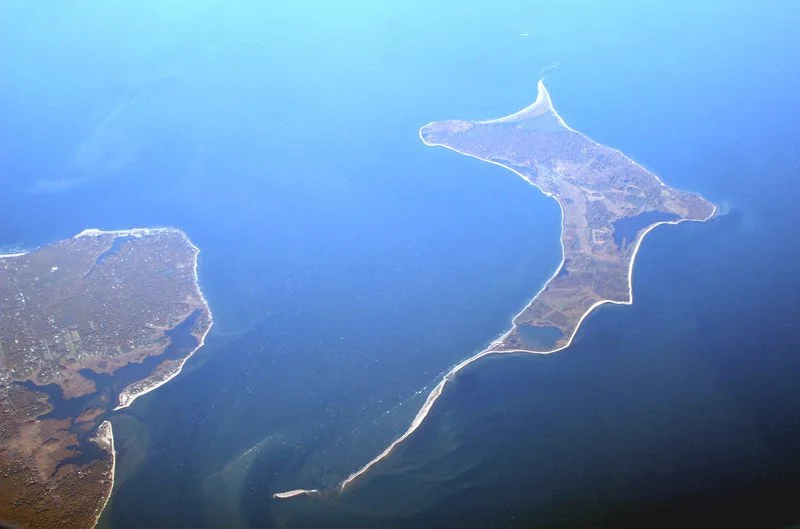
Photo: Doc Searls, Gardiners Island fly-over, 2007, Wikimedia Commons http://www.flickr.com/photos/docsearls/285538232/
Introduction: Before the Essays – A Question She Was Already Asking
Before she wrote the essays you've been reading, my mother as Town Historian gave this brief talk to the East Hampton Town Board in December 2005. You can see her thinking in real time — the questions she was already asking, the sources she hadn't yet found.
The talk is short. It covers ground that will be familiar to readers of this series: the French arrival at Newport, the British blockade, the refugees and their Connecticut shore towns. But what makes it worth sharing is not the information. It's the texture of her questions and search for facts.
My mother did not speculate loosely. So when you hear her ask, in the middle of a talk, "Were these 23 to 30 ships anchored on the southwestern side of the Island, protected by a long sandy spit that runs out to 'the Ruins'?" — and then add, matter-of-factly, "I have not found any diaries or other documents that discuss this" — you are hearing her research. She is at the edge of what she knows, still looking.
That was her natural habitat. She was most excited, I think, at the boundary between the documented and the unknown. She was in her own way a storyteller — saying aloud, even to the board, how her research was going.
The specific question she was circling in December 2005 was Gardiner's Island. Vice Admiral Marriott Arbuthnot — the British naval commander tasked with blockading the French at Newport — had chosen Gardiner's Bay as his anchorage. That much she knew. Twenty or thirty warships, filling that quiet bay just offshore. But where exactly were they anchored? What did it look like from the shore? Who was watching? She couldn't find anyone who had written it down.
The unpublished papers I found after her death included the essays that became this series. The thread she was pulling in 2005 runs directly into the material she gathered later — about the proprietors of Gardiner's Island, about Jerusha Buell Gardiner taking her four-year-old John Lyon to Hartford, about the foreman left to manage the farm, about British supply ships and what they took or simply requisitioned without a record.
Reading this board talk now, I keep thinking: she was already building the frame. What follows is what she found — and what she was still reaching for when she found it.
Below is her talk, lightly edited for clarity, presented as she gave it — informal, exploratory, alive with her characteristic delight in a good historical puzzle.
Talk to the Board
December 2, 2005 by Sherrill Foster, East Hampton Town Historian (2003-2007)
Greetings, Members of the Board, East Hampton Town,
This talk is about eastern Long Island during the Revolution, especially the nautical aspect. Long Island was captured by the British after the Battle of Long Island in August 1776. The new allies, the French, were coming into Newport, and the British navy was trying to keep that port closed.
In 1780, the French sent 32 transport ships to the colonies. They landed at Newport, Rhode Island — its excellent deep-water harbor was the attraction. The first ashore, in July 1780, were 1,500 sailors and soldiers, many sick with scurvy and dysentery. They were taken to makeshift hospital facilities all along the eastern shore of Narragansett Bay, all the way to Providence, where Brown University's University Hall was pressed into service. The majority of the French troops set up camp in tents on the high hill on the east side of Newport Harbor.
The British, of course, wanted to block the French within Narragansett Bay. The Vice Admiral was Marriott Arbuthnot — a man with a name like a hotel. His job was to blockade the entrance to the Bay. He had 6,000 British troops in his 23 ships. The plan was to attack the French forces in Newport, but Arbuthnot declared he knew nothing about Rhode Island waters. So nothing was done.
Gardiner's Island
Arbuthnot used Gardiner's Bay and Island for his anchorage and supply post. Were these 23 to 30 ships anchored on the southwestern side of the Island, protected by a long sandy spit that runs out to "the Ruins"? At those times, 200 years ago, this sandy peninsula was more formidable than it is today. These 30 or so ships must have really filled up Gardiner's Bay. I have not found any diaries or other documents that discuss this.
Why would Admiral Arbuthnot choose Gardiner's Island? It was an entity unto itself — under no colonial government except its own, per the manorial grant of 1665. Also, the proprietors were not there. David, the sixth proprietor, had died in the fall of 1774. His wife Jerusha Buell, daughter of the minister, moved to Hartford when her husband died, taking her son John Lyon, age four, the seventh proprietor. The Island was managed by a foreman who saw to the ongoing farm work. There was produce for Vice Admiral Arbuthnot to purchase — or to just take. There is no record.
Arbuthnot's ships patrolled the coast from this anchorage. The British were blockading Newport, the seat of the French encampment. But Admiral Arbuthnot and General Henry Clinton continued to have misunderstandings and miscommunications. They were ineffective in preventing the French from moving to aid General Washington.
Reconnaissance, and What Happened Next
In July 1780, Arbuthnot apparently decided to make a closer reconnaissance of Newport. French lookouts noted, on July 19, four frigates off Point Judith, then later eleven ships-of-the-line, five frigates, and four smaller vessels patrolling offshore. No fighting took place; it was an observation mission only.
In early 1781, Washington decided he needed the French force in the Chesapeake. The French in their ships left Newport in a light rain and fog. When Arbuthnot sent two ships out on a standard observation patrol — the Iris, 50 guns, and the Pearl, 32 guns — they reported back that the French had disappeared.
Arbuthnot's entire squadron put to sea. Although they left a day and a half after the French, they quickly overtook them — the British had copper-bottomed boats. The forces met at the mouth of the Chesapeake, where a battle took place. The French had 7 ships-of-the-line and 3 frigates, carrying 583 guns in total. The British had 8 ships-of-the-line, carrying 660 guns. One French ship lost its rudder. The French returned to Newport; Arbuthnot remained at the head of the Chesapeake.
In July 1781, Arbuthnot was replaced by a new commander, Rear Admiral Thomas Graves. Gardiner's Island, so far as is known, was not used as a British anchorage after that.
All this and more is discussed in John B. Hattendorf, Newport, the French Navy and American Independence (Redwood Press, Newport, R.I., 2005).