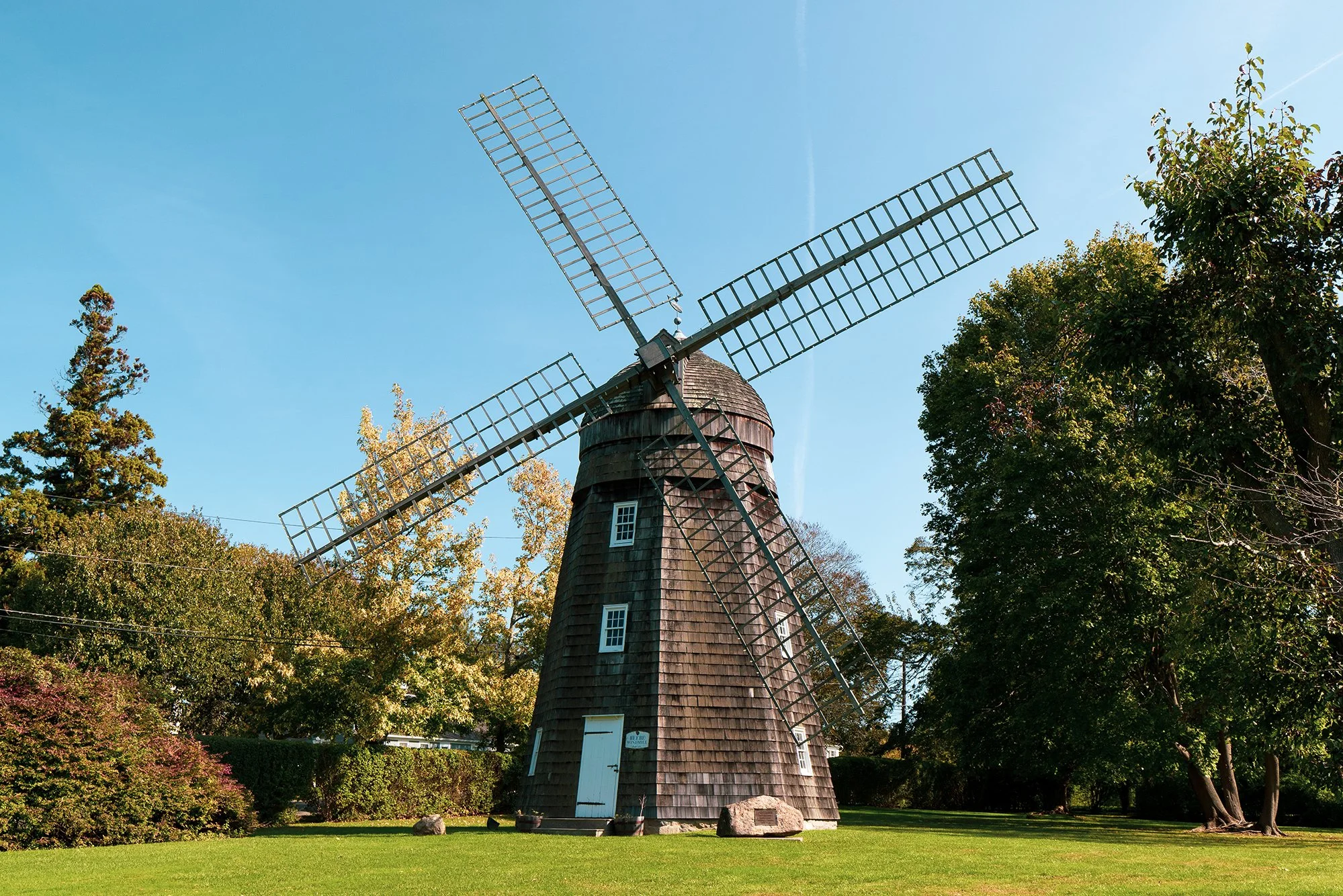
Photo: Beebe Mill, Southampton. Michael P. O’Connor, Wikimedia Commons, CC BY-SA 4.0
#4 in Our Windmills Were Our Workplaces, a series.
Introduction: Of wind and whaling
Windmills for my mother were not just romantic curiosities - they were works of architecture. They were designed with a purpose. They had owners and “architects” – the millwrights – and millwrights had different design philosophies shaped by evolving construction and skill. In that way, mills opened a door to an earlier world of design.
Who were the millwrights? Who wanted the mills built? Who was buying the flour? Why was there a mill building boom from 1800-1820?
This essay – the fourth essay in this series: Our Windmills were Our Workplace – focuses on six mills built during that boom. Many were bought and sold and moved – “leading to much confusion in research and discussion” as my mother wrote. In tracing their histories patterns emerge – most strikingly, the role of ship captains as investors, linking milling directly to maritime trade.
The heart of the story is a moment in time: the rise of Sag Harbor as a whaling port. Mills in Sag Harbor, Southampton, Water Mill, and Good Ground operated near enough to provision whaleships. She found that during the mill-building boom the price for flour nearly doubled. Owning a mill was profitable.
Captain Lester Beebe's "eyecatching" mill is, for me, the centerpiece to understanding the mills of Southampton. Retired from whaling, Capt. Beebe commissioned Samuel Schellinger to build what my mother would call "the latest thing" – a mill of cast-iron machinery and a "fantail," the self-steering device that kept sails facing the wind. It is the only surviving Long Island smock mill retaining its original cast-iron working – and one of very few in the United States.
As I worked through my mother's research I noticed how Schellinger's innovations – cast-iron components and the fantail – appeared on other mills. Because of these elements, several Southampton mills have been attributed to him.
She often began her articles with the big picture – Eastern Long Island's unusual heritage, with eleven historic smock mills still standing – more than anywhere else in the United States. Why here? Why have they lasted?
As I read more, I began to see that answer more clearly. No longer only handsome historic shingled structures, mills stand as workplaces, closely tied to the coastal economy that once defined everyday life.
Southampton’s Many Movable Mills: 1800 to 1919
By Sherrill Foster, East Hampton Town Historian 2003-2007
Sherrill Foster's study of East Hampton's windmills began with her 1976 master's thesis and continued through columns, talks, and walking tours into the early 2000s. This series draws on her research and writings, edited and expanded on by Mary Morgan, 2026. #4 in series: Our Windmills Were Our Workplaces
In the 1780s, mills were everywhere in New England—not as scenery, but as the working fabric of every town. With rivers and streams abundant, nearly every town had at least one watermill, often several, powering daily work: grinding grain, sawing lumber, and finishing cloth.
Windy coastal Eastern Long Island took advantage of its winds as well as its streams. Like Cape Cod, it had a mix of both. In the 1780s the post mill, simple, adaptable, movable, was the prevailing form. Historians note that as many as 40 windmills and 27 tidal mills once dotted the length of Long Island.
On eastern Long Island, eleven historic mills still stand —all smock mills—more than any other region in the United States, with Cape Cod the closest rival.
Today they appear as evocative landmarks on town greens, public parks, and a college campus, with the greatest concentration in East Hampton. They began, not as isolated structures, but as workplaces – part of a connected system essential to a coastal economy.
In the Southampton area between 1800 and 1820, six wind-driven gristmills were built within a few miles of Sag Harbor. Many were owned by ship masters, with families holding ownership across generations. For over a century they operated as a shared system, grinding grain into flour for local communities and for one of the nation's leading whaling ports.
These smock mills were designed from the beginning to be movable — set on loose stones rather than fixed foundations, with numbered beams that could be disassembled and reassembled.
And they were moved. Five of the six Southampton mills no longer stand on their original sites. Two left Southampton altogether; the rest were relocated within town. Only the Water Mill windmill remains on its original common green — and today, only four of the six mills, while moved, still remain in Southampton.
Six mills. This is their story: where they worked, who invested in them, and how they became part of a changing landscape.
Sag Harbor: Windmills and Whaling
By 1845, Sag Harbor was one of four dominant American whaling ports — alongside New Bedford, Nantucket, and New London — harboring 64 vessels at its peak.
Between 1784 and 1871, the period covered by the historical records, 574 whaling voyages sailed from Sag Harbor aboard 116 vessels. Though considerably smaller than the great whaling fleets of New Bedford (4,303 voyages) and Nantucket (1,402), Sag Harbor ranked sixth among 72 American whaling ports, establishing its place among the nation's significant whaling centers.
Provisioning that fleet — and the broader Atlantic flour trade — was precisely the business that made Southampton's windmills profitable.
Southampton's mill-building boom of 1800-1820 was driven in part by economics: between 1791 and 1820, wheat prices in the Atlantic trading world nearly doubled.
With flour in high demand at coastal ports and in the West Indies, investment in new mills made good business sense. That logic fueled construction across the east end towns: East Hampton, Shelter Island and Southampton. Although these mills changed hands during this era, they all operated within a few miles of the port at Sag Harbor — close enough to supply it efficiently, and close enough to be affected by its rise and fall.
Water Mill (1800): Southampton’s Earliest Smock Mill
The Water Mill windmill—sometimes called the Corwith Mill—is Southampton's earliest, and smallest, still-standing smock mill. It was built on Hog’s Neck in North Haven, Sag Harbor – by or for James Mitchel. The mill dates to 1800 and originally had one pair of millstones.
It was moved from Hog’s Neck by oxen cart to Water Mill in 1813 when the Corwith family purchased it. They rebuilt the mill, adding a second pair of grinding stones – one for corn, the other wheat and oats. The hamlet’s name dates to c. 1720 from references to “the water mill” built on the commons. By the 1800s the mill had become a fulling mill—that is, refining loomed wool cloth into a more durable fabric.
This small early smock mill is "winded" by a long tail pole that projects from the rear of the building. The miller, pushing on the "tail" would turn the body of the mill so that the cloth-covered sails faced the wind properly.
The tail-pole reflects an earlier, simpler design than the internal capstan-winder mechanisms the Dominys were refining in East Hampton during the same period (1795–1820). Still, it worked reliably. Its resemblance to mills on Cape Cod and Nantucket point to how building traditions traveled along coastal trade routes, linking eastern Long Island more closely to New England than to the rest of the island.
The Corwiths operated the mill on shared village land—today’s Water Mill Green—serving as a gristmill for the surrounding farming community with nearby coastal landings along Peconic Bay and Mecox Bay.
Owned by successive members of the Corwith family across generations, the mill operated until 1887, when it and its one-acre green became part of a private estate. The estate and mill changed hands five times – before the Order of St Dominic deeded the mill and its one-acre green in 1934 to the Village.
Owned and maintained by the Water Mill Village Improvement Association, the mill is preserved as a landmark and public park.
Set on the village green, the mill remains a reminder of shared ground and shared economy that once centered community life.
Shelter Island to Good Ground (1807): Coastal Trade
The Good Ground Windmill was built in 1807 by Nathaniel Dominy V for Sylvester Dering & Company on Shelter Island, where it operated for roughly fifty years before it was relocated to Good Ground (present-day Hampton Bays).
On Shelter Island the mill operated as a family enterprise rather than a community-based mill – similar to the Dominy-built mill on Gardiners Island built for John Lyon Gardiner. The Derings, major Shelter Island landowners, had a coastal trade business with small sloops and schooners, and supplied whaling ships at nearby Sag Harbor.
The mill reflects Dominy’s technical advancements, refined in the year before with Hook Mill, with two millstones increasing milling capacity, efficiency and safety.
In 1860 the mill was bought by Martin Van Buren Squires and moved to Good Ground. There it ran for another twenty years serving local farmers and supplying flour and meal for both local use and for coastal trade.
In 1880 C. Wyllys Betts purchased the mill to become part of his new summer cottage facing Agawam Lake in Southampton. It stands there today set back from Sebonac Inlet Road on a little rise, converted into a cottage.
From fifty years on an island to twenty on the mainland the mill’s relocation traces the needs of a changing coastal economy
Hayground (1809): The Last Working Mill
“Built 1809” is carved on the centerpost of the Hayground Windmill, though its builder remains uncertain. Its fantail suggests a connection to Samuel Schellinger – a feature he employed in other mills.
The fantail – a small, rear-mounted wind vane that automatically turns a windmill’s cap into the wind – was widely used in England and on Cape Cod. The wind vane freed the miller from the manual labor of adjusting the cap into the wind – either with an external tail-pole, like the earlier mill at Water Mill, or internally, as Dominy engineered for the 1807 Good Ground mill.
The mill stood between Water Mill and Bridgehampton, behind what is now Hayground School, owned by a syndicate documented as General Abraham Rose, Benjamin Rogers, Ethan Topping, and Nathan Topping Cook – land-based investors connected to the maritime economy. Its closest harbor was Mecox Bay, with landings along Noyack Bay just a few miles further, but it was close enough to Sag Harbor to cart goods to the port.
Descendants of the Rose family maintained and operated the mill across generations into the 20th century. It became the last operating mill on Long Island, continuing until 1919. This was a full 110 years, extending past the closings of Wainscott in 1912, and Beebe in Bridgehampton in 1915.
The mill became a familiar landmark in the landscape, used by the community, at times an artist's studio, until 1950, when it was purchased by Robert Dowling and relocated to his private estate on the dunes in East Hampton, where it remains today.
At Hayground, more than a century of family ownership speaks of sustained family investment and stewardship.
Wainscott (1813): Started in Southampton
What we now call the Wainscott Windmill was first erected on Mill Hill in Southampton, a site long associated with earlier windmills. It was financed by local investors including Jeremiah Jagger and Joshua Sayre, and later relocated several times, under both private ownership and community partnerships.
The mill is generally dated to 1813, and with its fantail wind vane, is widely attributed to Samuel Schellinger.
On Mill Hill it operated for nearly forty years with changing ownership. Captain Barney Green purchased it in 1840, moving it closer to his other mill on the green, allowing a single miller to operate both.
It was moved again in the 1850s when Captain Cornelius Conklin purchased the mill in 1850, moving it near his farm in Wainscott, eight miles east. He had applied to the Town Trustees to set it on common land there. The mill was now in a community of farming.
The mill operated in Wainscott for 50 years, passing from Capt. Conklin to Isaac King and remained in local hands. The 1860 Census of Industry provides a precise snapshot of its productivity: King ground 5,000 bushels of grain and produced $5,500 worth of flour and feed that year. This figure corresponds well with the records of other local mills—the three East Hampton mills each ground approximately the same amount in the same period, suggesting that 5,000 bushels was about the practical capacity for a well-run single mill on the East End.
At the end of the century the mill was still in operation. It was owned by Nathaniel Dominy VII who also operated Hook Mill, managing two mills within four miles of each other. It was last milled commercially by Osborne, Hand & Company until 1912 becoming one of four mills active into the 20th century – Hook until 1908, Beebe until 1915 and Hayground until 1919.
Then, in 1912, the Wainscott community gave the mill a new life as the Wainscott Public Library — remarkably, with its sails and fantail still intact. Its octagonal tower, with high ceilings spread over several floors, offered more room than many a one-room library, and because it stood on common land, it was open to everyone. The conversion suited its moment: libraries were opening across America as reading became something for everyone, not a privilege of the few.
In 1922 it took a sojourn to Montauk when Lathrop Brown purchased the mill transporting it to his estate on the ocean bluffs, a picturesque addition to the property. But it was not to stay. In 1942, with the federal government acquiring the Montauk coastline for military purposes — including Brown's property — he gave the mill to the Georgica Association in Wainscott.
Along the beach it travelled back to Wainscott, the last in its series of relocations, each move reflecting a different use – back to the community where it had spent 50 of its productive years.
Beebe Mill (1820): A Captain’s Investment
The most eye-catching and technologically innovative of all the Southampton mills is the one built by Samuel Schellinger for Captain Lester Beebe.
Now sited on a public green in Bridgehampton, it was once on Sag Harbor’s wharf — where it was originally built in 1820. Capt. Beebe had commanded a whaler and later became a prominent shipbuilder in New York City. The mill Schellinger built for him represents a technological leap for the region, incorporating cast-iron gearing and a centrifugal governor.
The combination of wood and cast-iron engineering, still intact, distinguishes it as rare—the only surviving Long Island smock mill retaining its original cast-iron machinery, and one of very few in the United States. It is uniquely decorative for Long Island, with an ogee cap (an onion shape with a finial at the top), a departure from local millwriting tradition and more comparable to English windmills of the same period.
Sag Harbor–based Samuel Schellinger was a versatile craftsman who used his engineering skills to build everything from schoolhouses to ships, and was clearly aware of new mill developments. The features he used in the Beebe mill—heat-resistant cast-iron gearing, a speed governor, and a fantail—were already in use in New York City mills, based on refinements introduced by the English engineer John Smeaton.
The centrifugal governor automatically regulated the speed of the grinding stones, preventing the “runaway mill” syndrome that was every miller’s nightmare: in high winds, sails could spin out of control, and with no grain to grind, the stones would spark and the wooden mill could burn. The eye-catching fantail served as an automatic pilot, keeping the cap and sails oriented into the wind. (The same fantail system was used on the 1809 Hayground and 1813 Wainscott mills, possibly as later additions.) Together, these three features—cast-iron gearing, governor, and fantail—were mechanical safety measures that Schellinger introduced to the East End.
Samuel Schellinger began building on the wharf in September 1820, working with two apprentices for 119 days until completion in January 1821. An additional 89 days of work by Pardon T. Tabor, a carpenter, was added to the cost. Schellinger also charged Beebe for five days’ travel to New York to obtain the cast-iron parts, going by boat to and from Sag Harbor.
Upon completion, the mill was moved to Sherrills Hill (now Oakland Cemetery). There it operated as a working mill while also serving as a navigational aid to sailors and signaling townspeople of arriving whaleships. With its distinctive ogee cap, knob, and extending fantail, the Beebe mill must have attracted considerable attention in its day.
The mill operated for decades on the hill until Lester Beebe’s death. In 1832, it was moved to the common in Bridgehampton, where it continued milling for another fifty years. Purchased by Judge Abraham T. Rose and Richard Gelston, it was later sold several times. Its fourth owners, James A. Sanford and N. N. Tiffany—operators of a steam-powered lumber mill in Bridgehampton—incorporated it into their broader enterprise.
Records note a mill blow-up in 1888, after which Nathaniel Dominy VII was hired to carry out extensive repairs. A later firm, the Bridgehampton Milling Company, operated the mill until 1915, when it was purchased by John E. Berwind, who moved it to the lawn of his Bridgehampton estate, “Minden.” After his death in 1919, his widow donated the mill and its two acres to the Town of Southampton as a memorial.
In its technological advancements, the Beebe Mill reflects both the ambitions of its builders and the evolving technology demands of the local marine economy.
Now a symbol of that former economy, it can be seen today on the John E. Berwind Village Green in Bridgehampton— a particularly delightful mill.
Shinnecock Mill Hill (c. 1820): A Mill with Mysteries
This smock mill, generally dated to 1820, takes its name from two places: Mill Hill in Southampton, at the corner of Windmill Lane and Jobs Lane, where it was first built; and Shinnecock Hills, where it was later moved—a name drawn from the Shinnecock Indian Nation, whose ancestral lands surround it.
Like the Wainscott Mill, which operated on Mill Hill for forty years before being relocated, the Shinnecock mill, too, stood on Mill Hill — for sixty years. It was moved five miles away to Shinnecock Hills in 1889, when purchased by William S. Hoyt for his estate. The Hoyts had acquired it from Captain Thomas P. Warner, the last owner-operator, indicating that the mill remained in commercial use up to that time.
Remaining on Shinnecock Hills ever since, the land itself has passed through several hands—from private estate, to the Tucker Mill Inn resort, and finally, in 1963, to Southampton College, now the Stony Brook Southampton campus—where the mill continues to be maintained and celebrated.
Yet the mill carries unresolved questions. Its sparse documented history makes its construction date uncertain; its millwright and early ownership remain unknown. The cast-iron machinery it is said to have once contained—whether original or part of later modification—has led some to attribute the mill to Samuel Schellinger. Whether Schellinger was involved from the beginning, or only in later alterations, is unconfirmed. Questions of land ownership, too, remain, as the Shinnecock Nation maintains that the Hills were ceded to them by treaty.
With its machinery long removed, the mill has undergone several restorations, including the addition of second- and third-floor windows that now frame expansive views of Shinnecock Bay and the Atlantic Ocean.
The college community marks the holiday season each year with a lighting ceremony on the first Friday of December. The mill stands within a layered landscape, where histories of ownership, land, and workmanship remain intertwined—a treasured landmark and an enduring part of the college’s identity.
Sag Harbor Replica (1966): Whaling Port Landmark
The story comes full circle with the Sag Harbor windmill at the entrance to Long Wharf, built in 1966 as a public memorial to the village’s whaling past. It is a scaled-down replica of the Beebe smock mill.
During the rise of whaling six windmills operated within a close radius of the harbor: two on Mill Hill (the Wainscott and Shinnecock mills), and others at Water Mill, Good Ground, Hayground, and in Sag Harbor itself (the Beebe mill).
At the entrance to the wharf, the charming replica now serves as a symbolic reminder —a tribute to the village’s maritime history and its working past.
Shared Landscapes of Investment and Stewardship
The histories of these six early nineteenth-century windmills on eastern Long Island—the Water Mill, Good Ground Windmill, Hayground Windmill, Wainscott Windmill, Shinnecock Windmill, and Beebe Windmill—reveal shared patterns: local investment, participation in the rise of whaling, generational ownership, and forms of preservation and community stewardship.
All six were built between 1800 and 1820, when wind-powered gristmills were essential infrastructure. Their investors included coastal traders and men connected to the whaling industry—Captains Beebe, Green, Conkling, and Warner. The mills’ most active years correspond with the rise and peak of Sag Harbor’s whaling economy, which expanded rapidly after the 1790s and reached its height between about 1800 and the 1840s.
The two prominent millwrights: Schellinger and Dominy represent different approaches to innovation. Schellinger embraced emerging industrial technologies, especially cast iron. Dominy developed a technology rooted in precision woodworking, local materials, and practicality.
For roughly eighty years, from about 1800 to 1880, the mills helped anchor local economies—grinding grain for farmers and supplying flour for local use. In many cases, they remained within the same families, passed down across generations. Their locations changed as well, reflecting shifting patterns of land use, ownership, and economic need.
Their milling careers largely came to an end in the 1880s, although several continued into the twentieth century: Wainscott until 1912, Beebe until 1915, and Hayground until 1919—operating for 110 years under continuous family ownership, the longest-running of the group.
The story of Long Island’s windmills is ultimately one of technological and economic change reshaping the East End landscape. Two developments mark the turning point: the rise of oil production in Pennsylvania and the expansion of the railroad. Whale oil was replaced by cheaper kerosene, shifting Sag Harbor’s economy away from whaling. At the same time, railroads began delivering flour from large-scale Midwestern mills to urban markets. When the railroad extended to eastern Long Island, it reoriented “shipping” from coastal waterways to inland rail lines, reducing the importance of small-scale maritime operations.
From wheat to potatoes, East End farmers adapted. Long Island’s sandy soil, long used for wheat, proved well suited to potatoes, a crop with growing urban demand. Within a generation, the wheat fields that had sustained local milling gave way to potato cultivation. As grain production declined, the windmills that had once anchored the region’s working landscape gradually fell silent.
The windmills did not disappear. As the economic world around them changed, so too did their value. They had been raised for use, set on common ground, and kept in motion by the needs of farmers and maritime traders. By the 1880s, mills were increasingly purchased for private estates—not to grind grain, but for their aesthetic presence and historical significance. Over time, they also came to serve as landmarks and reminders of an earlier era. They entered a second phase, defined by both private stewardship and community preservation.
Some of Southampton’s six smock mills remained in private hands, while others returned to public life — set on village greens and shared ground: Water Mill on its green, Wainscott at the Georgica Association, Shinnecock Mill Hill at Southampton College, and Beebe in a town park. Taken together, these historic mills — part of a larger group of eleven on eastern Long Island — stand as markers of a shared past.
It is a story of craftsmanship and innovation, of local investment and generational ownership—often sustained within the same families—rooted in a coastal and whaling economy, and ultimately, of preservation and shared stewardship.
Sources:
This essay draws on:
Dominy family account books, Winterthur Museum collection.
John Lyon Gardiner notebooks.
Samuel Schellinger business records.
1860 Census of Industry, Suffolk County.
East Hampton and Southampton Town records.
Long Island Collection, East Hampton Library.
Hefner, R. J. Windmills of Long Island. 1983.
Wetterau, Helen M. Shinnecock Hills Long Ago. 1991.
Delatiner, Barbara. “East End Windmills Are Grist for the Historian.” New York Times, July 17, 1977.
Hefner, Robert J., and Gregory B. Paxton. Beebe Windmill. Historic American Engineering Record (HAER No. NY-67). National Park Service, U.S. Department of the Interior, August 1977; transmitted April 1984.
Michael P. O’Connor. “Beebe Windmill, Bridgehampton, NY.” Wikimedia Commons, October 18, 2020. CC BY-SA 4.0.
Wikimedia Commons image page
